I’m the problem

This blog is typically written in the plural first person, but for this subject, I am writing in the singular first person, evident in the fact that I just wrote ‘I’.

The reason for that, is that this subject is incredibly important if you want to have a faithful approach to fixing big problems. This idea is not original, I did not come up with it, indeed you should hope that nothing I write is truly original, because that would be a rather good indicator that it was not trustworthy.

A number of factors, including the proliferation of the internet, the advent of international community and coordination, and the reality of a Big Sneeze that has visited every country, have meant that many people today, and young people especially, are looking to the world’s problems, and trying to fix them.

If you read Dr Jordan Peterson, the lobster king, you will be familiar with the adage ‘clean your room’, which is a shorthand way of saying ‘fix your own domain up before you fix the world’. In turn, Peterson acknowledges the origin of this concept in Scripture, specifically in Jesus’ famous teaching about ‘taking the log out of your own eye before taking the speck out of your brother’s eye’.

Like you, gentle reader, I am a sinner. Though Christ has made me alive, declared me righteous, and is conforming me to his image day by day, I still have a sinful nature to battle with, and that sinful heart is a constant factory of idols. It isn’t fun to write that, but if you truly are a Christian, you know what I mean, and you will be giving your amen, because it’s the same story for you.

I need to take accountability and responsibility for the consequences of my actions. That probably sounds quaint and obvious, but is unbelievably difficult to execute. I must confess that even in situations where I have seen consequences on the horizon, I have still proceeded forth. Then, when the pain or disgrace of reaping what I have sown is before me, I am pleading with God for mercy. Undeserved, so undeserved, almost inappropriate, since I knew what I was getting into. But that’s just it. God loves me even then, and does not want me to wallow in shame for a moment before running back to him. I imagine that this is what the songwriter was feeling when he wrote those oft sung words,

Prone to wander, Lord I feel it

Prone to leave the God I love

Here’s my heart, oh take and seal it

Seal it for Thy courts above

Come Thou Fount

The heart that has been resurrected by God’s Spirit is a heart that longs to be bound to righteousness. It is for this reason that I, with Paul, am glad to be a slave of Christ, for He is the safest dock in which to be moored.

Esteemed reader, it is the advice of giants of the faith before me, and my own experience, that a deep and true acknowledgement of your own sinfulness is actually a key to freedom from bitterness and a resentful attitude. The easy thing to do when faced with an unpleasant situation is to blame other people, but the wise thing to do is to firstly acknowledge the part you played in making it worse, and if possible remedy that, before you start pointing fingers. I will admit, I have complained about ‘the problem with society’ or ‘the problem with the opposing political party’ or ‘the problem with that Karen at church’. On the other hand, have you ever heard me in smalltalk mention ‘the bad habit I contribute to in our society’ or ‘the bias I have that the opposition political party rightly criticises’ or ‘the sinful attitude I brought to my interaction with a lady at church’? Sadly, the answer is probably no.

Having had more close encounters with sin that I care to admit, I can firmly say that my ongoing repentance and holiness should be my top job. Spiritual pride comes on quickly, oh so quickly, like a fully locked rear naked choke (Brazilian Jiu-Jitsu reference, nothing NSFW). So I can say, and if you are a Christian I hope you can say with me, that my sin is something that I see clearer and clearer the more I try to uproot it and destroy it. It is something that seems larger and larger the more you abhor it.

In fact, it is right and good to feel that way, because only the Holy Spirit produces in you a righteous sorrow in the face of your own sin, and you should be glad to see the outworking of the Spirit’s work in your life.

It astounds me, when I have just come to my senses after an angry word or an impure thought, that God isn’t going to give me ‘one last chance’ one day, and then finally cut me off. God is somehow, amazingly, glorified in his monergistic act of saving me. He saved me by himself, for himself, and from himself. And oh, how grateful I am. O, for a thousand tongues to sing my great Redeemer’s praise!


Postscript: for a similar engagement with this issue, please check out this article written by a dear brother of mine. For a wonderful song on the subject, with the same title, check out this track.

The next few millennia of the End Times, and a comparison to the Quadrennial phenomenon of Olympic expertise

Due to some global news events you might’ve heard about, something about a virus I think, and some subsequent questionable moves by certain politicians, Christians have been talking a lot about the End Times. However, for much of the church, and in this case the Western Evangelical church, it is a subject that is often ignored or only discussed superficially. Many dismiss the study of the End Times, or eschatology, to be ethereal doctrine that has little to no practical impact on how one lives their Christian life, but right now we are witnessing how people’s actions and attitudes are indeed shaped by what they think will happen in the future.

Many books, and large ones at that, have been devoted to attempting a comprehensive explanation of Christian eschatology. We will not be attempting a comprehensive study here, but we will introduce a few foundations so that our eventual disagreements can be sustained within the realms of Orthodoxy. We will then consider issues with the framing of eschatological differences in Christian conversation, and finally this author will make specific comments on some elements of the subject where he plants his flag and is prepared to engage in hearty debate.

Firstly, a note on perspicuity. The Christian Scriptures are the result of the self revelation of the True and Living God, who told us that his memorial name is Yahweh. He is a communicating God, with both intra-trinitarian communication and communication with his creation, us. He has inspired and preserved his word that we might learn from it, and he has given it with enough clarity that he will judge us by it. The Scriptures are essentially understandable. Admittedly, scholarship and study are required, but that doesn’t compromise the fact that the Scriptures can be known and understood. One of the earliest enemies of the Christian faith is Gnosticism. Paul writes against it in much of his work. What’s more, gentle reader, if you have been reading these theological reflections for any length of time, you will have encountered our engagement with Gnosticism as well (though we do not blush to say that Paul did it better).

The place where Gnosticism rears its ugly head is that it denies the idea of the perspicuity of the Scriptures, and a Gnostic attitude to reading the Scriptures will motivate you towards looking for the ‘secret truths’ or the ‘buried original meanings’, or perhaps pseudo-translations of the Scriptures that are geared towards ‘unlock[ing] the passion of God’s heart and express[ing] his fiery love’. Another expression of Gnostic hermeneutics would be the idea that something other than education in the original languages and historical context is absolutely necessary for proper exegesis, such as spiritual pedigrees or lines of pastoral/apostolic tradition that might incline a leader towards acting as if they have ‘access to higher truths’ or ‘new and never-before heard words from God’.

The foundation of perspicuity is the belief that God’s word can be understood, and that it is not hiding secrets and novel doctrines that have never been seen before.

Secondly, a note on audience. The Scriptures are written by God, through people, to others, about Christ, for us. That was a mouthful, take a second to chew it and wash it down. All of Scripture is for us, but strictly speaking, none of it is to us. We are reading someone else’s mail, and yet we are commanded to live in light of it! This simply means that we must do proper biblical and systematic theology when we read the Scriptures. Leviticus is for us, and so are the Psalms. Matthew is for us, and so is Hebrews. However, Leviticus was not written to you, Moses didn’t secretly have 21st century Australia in mind when he wrote the Law. This remains true, even if, as we see in some parts of the New Testament, those things were written for us or took place for us, as teaching tools. This shows dual authorship in action. Moses didn’t know about you when he was writing, but the Holy Spirit did. In the same way, each Gospel account was written for a certain demographic or people group, and none of those were 21st century Australian Christians. All of it is for us, none of it is to us.

Third and finally, a note on mission. God’s word has given you plenty to do. To be honest, the letter to Ephesus alone has given you plenty to do. There is so much room for growth in the faith, even with the simplest of matters (e.g. patience, forgiveness, holiness). This author, though still early in years, can see many lifetimes of sanctification ahead of him. A bishop called Ryle has had some influence there. The reason we mention this is that potato chips have something in common with Christian teaching. People have grown tired of the ‘Original and the Best’, and now stray into such ‘new and exciting’ flavours as Loaded Baked Potato, Cappuccino, Crab flavoured, Wasabi Ginger and Mint Mischief. Many, catechised into a consumerist society, have grown tired of what is plain and well-known in God’s word, and now search for new and exciting doctrine. Woe for the day when Wasabi Ginger or Mint Mischief make it into your Study Bible! But seriously, consider what we are saying, and how wonderful it is. We’ll have homework for all eternity, I imagine, and how exciting is that! To think that you may always have another degree of God’s brilliance and power still to discover! The point is this. Many movements and fads today are the result (we contend) of people finding the Bible stale, and considering it to not have enough exciting new stuff for them to pursue. 

To apply those three principles to eschatology, let us make this summary: Revelation has been fully understandable since the day it was written; Revelation was not written to you, and there’s plenty for you to learn about Revelation and all eschatology within the bounds of clear exegesis and historical Christian Orthodoxy. You would be surprised how many Christians long for truths that have been known for centuries, and simply neglected because they are kept in books with unimpressive titles or dust-jackets.

Here is a fact of history for you. Matthew 24 was understood by the people it was written to. They acted upon it, and did so correctly. Jesus told his followers about events of cosmic significance that would all happen in their generation. He told them that when they saw the abomination that causes desolation, those Christians who were in Judea were to flee to the mountains (Matt 24:15). So, when they saw ‘Jerusalem surrounded by armies’ (which is Luke’s way of referring to the abomination that causes desolation to a non-Jewish audience that wouldn’t have understood that phrase; Luke 21:20), they fled to the hills of Judea. If you stop and think about it, that’s amazing. Jesus prophesied accurately down to the very details something that would happen nearly 40 years in the future. In fact, Jesus’ accuracy with that prediction causes many unbelieving scholars (whether they profess the faith or not) to insist that Matthew was written after A.D. 70. (we shall talk more in another post about how worldview affects data). We know that those first century Christians escaped to a place called Pella, both from the archaeological evidence and from Eusebius’s Church History (3.5.3). Brothers and sisters, (and make sure you are sitting down), we even contend, and with great apprehension, that if that prophecy had not been fulfilled, Jesus would be a false prophet. Anyone who wants to assert that Matthew 24 refers to future events, likely appealing ‘multiple fulfillments’, must justify why that prophecy is expected to have successive fulfillments, and how many, and why not every prophecy is expected to have such numerous fulfilments. Otherwise, you could not correct someone for claiming that any old thing that happens to them is a successive fulfilment of some obscure Old Testament prophecy. The ball is in your court.

In fact, after Jesus had prophesied all the judgements on covenantally unfaithful Israel, he gave them an idea of timeframe.

“But concerning that day and hour no one knows, not even the angels of heaven, nor the Son, but the Father only. For as were the days of Noah, so will be the coming of the Son of Man.”

(Matt 24:36-37, emphasis mine)

Here is the paradigm Jesus sets for his coming in judgement forty years later. He says it will be like the days of Noah. In Noah’s day, people were going on living their lives, and when judgement came, all who were not in the ark were swept away. Those who remained on the Earth were the God-fearers; Noah and his family. Let’s put that to you one more time. In Noah’s day, the evil were taken away, and the righteous remained on the Earth. Now let’s see Jesus applying it to that generation. 

 Then two men will be in the field; one will be taken and one left. Two women will be grinding at the mill; one will be taken and one left. Therefore, stay awake, for you do not know on what day your Lord is coming. (Matt 24:40-42)

Due to the ‘Left Behind’ books and films, most of the Western church has it backwards, thinking that the Christians will be ‘taken’, and the non-Christians ‘left’. Some films would even have you believe that your socks, shoes and belt buckles might remain on the Earth as you fly up into the sky in your birthday suit, alongside your friends from church. Picture that! Actually, nevermind.

Whether you believe in some kind of rapture or not, the one that much of the West believes in today is simply false. The way Jesus taught it, the believers remain.

It should be noted that even great exegetes and giants of faith will have varying interpretations of this chapter (and its synoptic partners). John Murray separates the first part of this chapter into three sections: v4-14, v15-28 and v29-31. As far as this author can see, it appears that part of the reason for this is to solve the problem of Matthew 24:34, which says ‘Truly I tell you, this generation will certainly not pass away until all these things have happened’. If the ‘all things’ of v34 covers everything preceding it, then v29-31 must be a past reality, which Murray says “did not occur in the generation of which our Lord spoke” (Murray, J in Murray, V 1977, ‘The Interadventual Period and the Advent: Matt. 24 and 25’, The Collected Writing of John Murray, Versa Press, East Peoria).

The problem we see with Murray’s interpretation is that he assumes that ‘the end’ referenced in v14 refers to the end of our current age, rather than the end of the Jewish age in which Jesus was speaking. Additionally, he assumes that v29-31 must be in the future, therefore he introduces divisions into this part of Scripture that we find unnecessary.

That was fun, wasn’t it? Let’s do it again. When the Revelation to John was written, the people to whom it was written understood who John meant by the beast (when we use the phrase ‘the beast’, please assume that we are referring to the first beast, or the ‘beast out of the sea, since the controversy does not surround the identity of the second beast, or the ‘beast out of the Earth, nearly as much).

The following is Douglas Wilson’s succinct introduction to this character, the ‘beast from the sea’:

“At the beginning of this chapter, we have the introduction of the great beast from the sea. This is one area where most commentators agree—a remarkable feat given the nature of this book. This beast is best understood as representing the Roman Empire, for some of the following reasons:

The sea represents the Gentile nations generally (Is.17:12; 60:5). In Daniel 7:1-7, we are given a description of four beasts, representing four successive empires. The fourth in that series was the Roman Empire, and the description of the beast here largely matches the description given by Daniel.”

(Wilson, D 2019, When the Man Comes Around, Canon Press, Moscow, p. 148)

That explanation shows the importance of reading the Bible with biblical categories and motifs, rather than bringing a 21st century material literalism to everything. He goes on to explain another element of how this beast is described:

“Rome was known as the city of seven hills, and additional information gleaned later (from Rev. 17:9-11) tells us that the seven heads of the beast were doubly symbolic. They represented seven kings, and they also represented seven hills. Rome was known in the ancient world as the city of seven hills, and just as we recognise the Big Easy as New Orleans, or the Windy City as Chicago, so the first century readers would have instantly known that we were talking about Rome.

The fact that the seven heads were seven kings also helps us date the book using internal evidence. Beginning with Julius Caesar, Rome had seven emperors during this period. They were Julius Caesar, Augustus, Tiberius, Caligula, Claudius and Nero, followed by Galba who reigned a “short while”, meaning just a few months. These heads, we are told, were crowned with blasphemy, and it is striking that Caesar worship began in the reign of Augustus, and was particularly intense in Asia Minor—where this book was addressed.”

(Wilson, D 2019, When the Man Comes Around, Canon Press, Moscow, p. 148)

The lesson here goes back to our foundation of perspicuity. These descriptions aren’t some great mystery that no one has ever truly understood, or anything like that. They were a bit of a riddle, but the riddle was one that the first readers could actually understand, and at that, even better than most of us! To put it simply, the first beast was Rome generally, and Nero specifically.

That idea might sit uncomfortably with you. We feel no need to argue that the beast was a person who is now long dead, that much is unavoidable. Let’s take a moment to talk about Gematria and the Syriac manuscripts. Ok, so Gematria is not something you want to get too interested in. It’s a prime example of all that ‘hidden code’ ‘secret rules of the universe’ stuff we’ve already denounced. However, we do have to understand it to understand the most well known number in the Bible; Six-hundred and sixty-six. In Hebrew, Latin and Greek, they didn’t have numbers. In today’s English, we use Roman letters and Arabic numerals. However, in Hebrew or Greek, letters corresponded to a numeric value. Most of us are familiar with this if we’ve ever seen an analog clock. IV is four, XI is eleven, all that jazz.

Revelation 13:17-18 explains that the ‘mark of the beast’ represents ‘the name of the beast or the number of its name’. Oops, look at that, there goes all the theories about barcodes and microchips right out the window. Forget about all that. John calls for wisdom, and asks the reader to calculate “the number of the beast, for it is the number of a man, and his number is 666”. We can confidently say that the number 666 corresponds to the name of a man, and that that man is the specific representation of the first beast, aka the beast out of the sea. The second beast, on the other hand, is a different character, who is identified as the beast out of the Earth. We mentioned Syriac manuscripts a moment ago, and let us say, you will never have found Syriac manuscripts so juicy as you will now! The name Neron Kaisar, when transliterated into Hebrew, has the numerical value 666. The reason John didn’t write ‘the beast, who is Nero, is going to be overthrown and killed!’ is because he was a political exile, and his letters didn’t have end-to-end encryption, so that type of blatant dissidence might’ve greatly reduced his life-span. He gave them a little riddle, and it would’ve been perfectly understandable.

However, the Scriptures have been translated into many languages since then. What do you do when you’re copying Revelation in Syriac and an important point John is making about Nero requires the numerals of Hebrew? Why, you change the number of the beast, so that the Syriac numbers will also be equivalent to Neron Kaisar. As it turns out, that’s what happened. Your Bible may tell you in the footnotes, if it has footnotes, that some manuscripts read ‘616’. This isn’t a mistake. This is people understanding that 666 is equivalent to Nero’s name, and changing the number to fit the maths of their alphabet, since it is his name and identity, more than the number, that is important.

So, while we’re here, stop calling the leader of the political party you dislike ‘the Beast’. Stop calling vaccines the mark of the beast. It’s embarrassing to watch. 666 is not a reference to barcodes and the Great Reset and Bill Gates. Stop it.

One major set of elements in this discussion that are past their use-by date and ready to be unceremoniously discarded are the ways in which we misframe the disagreements.

Let’s firstly talk about Millennial differences–and no, we don’t mean those differences that manifest in smashed avo toast and thrift shopping. Some wise commentator whose name escapes us once said, and aptly at that, that the Millennium is one thousand years of peace that Christians like to fight about. Indeed, many people start the eschatological taxonomical process by asking “are you premil, postmil or amil?” To spell out that question, the person is asking “do you believe that the Millennium will occur after the Second Coming of Christ, before the Second Coming of Christ, or do you believe that it began at the Resurrection and will end at the Great White Throne judgement?”

This makes the fundamental division of Eschatological views center around one detail that is mentioned once in Scripture, and one which we suggest has relatively little impact on your actions compared to other escatological details. Indeed, there are many functional similarities and overlaps between those three Millennial positions. Gentle reader, if you are now regretting telling your brother or sister that they are in danger of apostasy for being Amillennial, now is your cue to ask for their forgiveness.

Another useless set of badges that the Western church created to know which Christians to throw rotten apples at are whether you are ‘pre-trib, mid-trib or  post-trib’, and then for each of those three categories, whether you are ‘pre-wrath’ or ‘post-wrath’. We will not go into all of the several combinations of those categories, but they basically serve to describe (a) if you hold to a Dispensational Premillennial view of the ‘rapture’, and then (b) when it occurs in relation to the ‘Great Tribulation’, and then (c) when all that occurs in relation to the wrath of God and of Satan, respectively. Luckily for those of us in Australia, the fights over those categories are mostly limited to the great land of the free, where many of those positions were created.

As we write this, we vaguely feel as if many pearls were just clutched at. Alas, but these things must take place, and trust this, they are only the beginning.

‘Ok’, the steamy reader might retort, ‘if you don’t like those categories, what categories should we use to determine who believes what?’

What we will suggest here is not the slightest bit new or original, and when it comes to Eschatology, it pays to be historical and orthodox, not novel. The ‘four views’ of the Revelation to John, though focalising the subject through one book, are probably the right place to start taxonomically. We would say that these give the broadest hermeneutical principles for how one approaches the study and subject of the ‘last things’ or ‘end times’ in Scripture, and in particular in the Apocalypse (yes, we love calling the last book of the Bible a variety of different things, it keeps you on your toes!) These four are as follows:

  1. Historicism
    • Historicism basically sees the fulfillment of much of Biblical prophecy taking place throughout the past, in the present, and into the future. This creates a very long timeline, in which the Book of Revelation is sometimes treated like a very slow roadmap (pardon me Victorians, I know the phrase ‘very slow roadmap’ is not something we are fond of). Historicists may say the ‘period of the Church of Pergamum is coming to a close, and we are beginning the period of the Church of Thyatira’. That’s not a direct quote, just a hypothetical example. Though this author does not hold this position, he is bound to respect it, since it was held by many of the Protestant Reformers such as Luther, Cranmer, Calvin and Knox.
  2. Futurism
    • Futurism sees most of Revelation, and key parts of Daniel and Ezekiel as still awaiting future fulfillment, e.g. Daniel’s 70th week (look it up if you don’t know what we mean by that, this article is already threatening to burst its seams, and then we’d be spoiling both the wine and the wineskin! What would Jesus say about that! Forgive our fast and loose bandying with and mixing of metaphors, sil vous plait). This view is closely aligned with Dispensational Premillennialism, but until that system was created, it was shunned by most non-Catholics. One major challenge with Futurism is that it necessitates a ‘revived Roman Empire’, due to the nature of the prophecies in Daniel and Revelation.
  3. Preterism
    • Preterism is actually straight Heresy, (ooh look, even a capital H!) because it asserts that everything in Revelation has taken place. That is a fundamental denial of any meaningful concept of the return of Christ, the vindication of the saints, the judgement of all the earth, etc. However, partial preterism, (which is the view proffered by this author) hears the announcement over the speakers that ‘this train is an express service running direct to Heresy station, stopping no stations’, and gets the heck off just in time. Partial preterism is the position that some of the things in Revelation have already taken place, and some are still to come (see, not so scary now, and no heresy either, which is nice).
  4. Idealism
    • This way of reading Revelation treats a lot of the major characters that appear after the seven letters as being symbols or types that describe various historical and still yet to come conflicts that face or have faced the Christian church. This view may tend towards turning things that seem concrete into symbols, but it makes the reading easy because you can do a lot of interpreting, and you don’t have to read much history.

If you want to read more on that, countless books have been written, and we would encourage you to consider all four very carefully. However, we want to steer this in a different direction. Let’s talk meat and bones, let’s talk about how it affects how you live and make decisions.

Some Postmillennialists, like this author, will (though with a degree of friendly rhetoric) suggest the terms ‘‘pessimillennial’ and ‘optimillennial’ as the essential distinctions between eschatological frameworks. The reason for that is that Postmillennialism is a uniquely optimistic framework. To the Amillennialists who disagree and claim an optimistic framework, I say that one or both of us does not understand your system, and it may very well be this author. Postmil folks have an essentially optimistic view of the future, because we expect Christ’s kingdom and his government and peace to slowly spread over all the Earth, so that the final scenes of this world will be of global victory, not global defeat, with one First Baptist Church somewhere in Texas being the last True Church on the planet. Since we don’t see the world ‘going to hell in a hand-basket’, and since we are waiting for probably thousands of years of world evangelism still, we consider it thoroughly worthwhile to build and build and invest and plant so that our great grandchildren’s great grandchildren might be able to benefit from what we left them. Aside from this being us unashamedly plugging Postmillennialism, this is an example of what we mean by applied eschatology.

Others, those who we might call ‘pessimillennialists’, are ultimately pessimistic about the future of Christ’s true church on Earth. They appeal to remnant theology, and the idea that God’s true people are always a small remainder of the visible assembly on Earth, whether they’re the elect during the Old Covenant or the elect during the New Covenant. They think about the world as a place ultimately controlled by Satan, where things will just keep getting worse, so there’s really not that much point polishing brass on a sinking ship.

We will not mince our words in saying that we denounce this attitude. The central eschatological thrust that all Orthodox Christians can affirm is that Christ will return bodily one day, and that that is very good news. Whatever your positions are on the little things, we hope that your doctrine of the End Times encourages you to build, to invest, to work the ground and kill the weeds, to reach the lost and fund Bible translation into languages that haven’t even begun to be written yet.

Every four years, everyone suddenly becomes an expert on the Olympics, and every man at his armchair becomes accredited to give critique and assessment to the most elite athletes from around the whole world. (This writer may indeed be guilty of having become temporarily very interested in a number of sports).

In the same way, major movements and dramas in history are often quickly and unnecessarily drawn into the realm of eschatological speculation and then dropped. Since we don’t talk about eschatology enough (or well enough) most of the time, when it does come up, every theory seems plausible. It’s this carelessness that has seen public figures (Henry Kissinger, Pope Leo X, Napoleon Bonaparte, Adolf Hitler, John F. Kennedy, Mikhail Gorbachev and even Pope John Paul II!) throughout history misidentified as ‘the beast’ and ‘the antichrist’, even by such glowing characters as Martin Luther (who accused Pope Leo X of being the Antichrist).

We will be blunt: Don’t make a fool of yourself and become the proverbial boy who called wolf by calling everything the mark of the beast. Stop it. There’s always going to be some terrible world leader who starts a rumour about a war and then overnight there’s an amateur documentary about how he’s the Beast. It’s embarrassing. One little note to add here: We think there’s room to say that certain men throughout history (Mao, Stalin, Hitler, Pol Pot) have acted in the same spirit or manner as the Beasts of Revelation 13, and so some very light comparison can be made to comment on how much of a terror such men have been, but that is using an analogy to reflect on human evil, not eschatological speculation.

Now, my dear Theophilus, we will switch focuses somewhat, whilst staying broadly in the same food court from which we have been eating. Please, we adjure you, pay attention to the core point of our following criticism, for it is this: the modern reader, especially if they are Western, and even more especially if they are American, takes it for granted that the ‘State’ currently called Israel which perches on the shoulders of Palestine is identical with the ‘all Israel’ (that will be saved) in Paul’s discourse in Romans 11:25-32. We will henceforth treat this assumption as a positive claim, and therefore begin this discourse not by levelling a rebuttal, but by asking for substantive argument for that claim, since a substantive argument is not made when this position is taken a priori. A good thought experiment that demonstrates this is to ask the 21st century Western Christian what interpretation a faithful Evangelical might have had of Romans 11:25-32 in the late 19th or early 20th centuries, when Greater Palestine was controlled or administered by the Ottomans and the British? One could not read ‘all Israel will be saved’, pull up a map, point to Jerusalem, and say, ‘ah yes, this is what Paul refers to’.

Have we made our point? This author will make no pretence of neutrality or dispassionate academic interest on this subject. We find it to be a historically untenable position that the judicially hardened Israel spoken of in Romans 11 can be easily identified with the settler-colonial nation of the same name that currently exists in Historic Palestine. This is possible, but by no means self-evident, and would reasonably require a positive case that is comprehensive and compelling to be made before it could be taken a priori.

This connects to what we established earlier about the audience of Scripture. Romans 11 was not written to you, it was written to first century Christians living in Rome. Also, because of the perspicuity of Scripture, those Christians will have been able to understand who Paul was referring to. If you bristle at this because you want to defend your idea of who Paul refers to in this passage, consider this: you must assert that Paul was unintentionally prophesying a future event, or that Paul was intentionally obfuscating his argument by referring to a future people with terms that already had established meaning in Scripture.

Let’s move on to the manner in which today’s ‘Israel’ was created. The first thing we can say is that it was not done by Christians, whether Messianic biological descendants of Abraham or otherwise. It was not done on the basis of Just War Theory, for which there are categories in Christian doctrine. Though one cannot simply describe how and why it was done, it shouldn’t be controversial to say that geopolitical motivations were prominent, not religious/prophetic/eschatological reasons. Herzl and the Zionists were a political and essentially atheistic movement.

The conquest of Palestine by the Zionists after the British Mandate is not comparable to how Joshua was commanded to conquer Canaan, not at all. Joshua was given direct revelation from God, he was given specific and limited instructions to seize the land God had promised his people and kill the people who resided there. Let us say as a side note that God would be entirely just in commanding any person or nation to destroy any other person or nation, because there is clearly and well established pattern in Scripture of God wielding unrighteous nations as tools of punishment and chastisement for other nations. However, this doesn’t mean that when a power-hungry leader annexes their neighbouring country, that they can say they are being wielded by God as a sword of Divine Judgement. In fact, that would be a 3rd Commandment violation. To claim that the conquest of Canaan establishes a precedent for the colonisation of Palestine is to establish a very dangerous precedent. That would permit anyone to appropriate the sections of God’s word where an individual is given a specific commandment and apply it with God’s authority to their life. Imagine someone saying that murdering their political rival was established biblically because of the climactic events in Esther, or imagine a young Egyptian Christian reenacting God’s judgements via Moses to disastrous effect!

To put it more simply and clearly, those things were God’s revealed will, but the colonisation of Palestine wasn’t. Now, all things happen according to God’s decretive will, but let no one make the elementary mistake of appealing to God’s sovereignty as a justification for their immoral actions.

If you hadn’t already suspected or deduced as much, this author is unashamedly pro-Palestinian.

This is because of a number of combined factors, including the unlawful nature of the establishment of ‘Israel’, the false justice of punishing Palestinians for the sins of Germans, the plight of the Palestinian people today, the asymmetry of the conflict, international law, and more. Now, (and you might say, mercifully), we’re not going to go through all of those things comprehensively. We do actually want some of you to finish reading this essay.

We will address a hypothetical that many ask: ‘what would you have done to fix the conflict?’ Our answer is this: as ethnic Jews fled various parts of the world to come to Palestine, it would have been more lawful for them to become Palestinian citizens (we are aware that this was not exactly possible, given the Palestinian people’s timeless lack of self-determination or independent nation-hood). One nation, one ‘nationality’ and as many ethnic and religious groups as you like. This is, incidentally, how many modern nations work. You can be an Australian yet come from all the nations of the Earth. However, you don’t come here and set up your own private enclaves and parallel economies. You learn English, and you invest in the country that has welcomed you and given you the right to call it home. Let us say this clearly. This author thinks it would have been more in accordance with God’s revealed will (more lawful, more truly fair) if the modern state of ‘Israel’ had never been created. However, God is the author of history, and not this author, so we will not go as far as to say that it should have happened differently, in the ultimate sense, because that would constitute a challenge against God’s wisdom, and well, we rather enjoy being alive.

The political discourse in the last 20 years has largely surrounded ideas like the ‘two-state solution’, and the ‘reality on the ground’. In short, those two things are mutually exclusive of one another. The ‘reality on the ground’ is the fact that the Settlers have effectively complete control over Historic Palestine, a status that they only wish to expand and increase. The ‘two-state solution’ is essentially the idea of there being two distinct, independent, sovereign states; namely, Israel and Palestine, whose borders would roughly follow the Green Line (a.k.a the 1949 Armistice Line). To spell it out, the reality on the ground is that ‘Israel’ has 9 marbles and Palestine has 1. The two-state solution would give both of them 5 each, and, well, the Settlers want to keep their marbles. Many commentators say we are heading towards an inevitable one-state solution, but there are a number of complicating factors that might prevent this, unless the Settlers are willing to go to Holocaust levels of purging, and wouldn’t that be ironic.

Ok, that’s enough on Israel/Palestine. We are going to propose a number of ‘eschatological bumpers’, which are hopefully straightforward texts that can give us some safety bumpers to help us stay within the realms of what is clear about Christian end times doctrine.

First things first, let’s look at 1 Corinthians 15:20-28. Paul is teaching on the general resurrection, an important end times event. Let’s see how he builds his argument:

  1. Christ has been raised from the dead
  2. As the firstfruits of the dead, Christ’s resurrection proves the resurrection of all who are ‘asleep’ in him.
  3. Death came through a man
  4. Because of (3), the resurrection of the dead also comes through a man. (Side note: this argument alone necessitates the teaching that there was no death or sin in the world before Adam, which challenges most evolutionary worldviews. Conversely, rejecting the idea that death came through Adam falsifies the premise Paul gives for why the Christian can expect resurrection).
  5. Just as surely as the fact that all people who are in Adam will die, you can trust that all people who are in Christ will be made alive.

This is the point where in a few short verses, Paul puts down an understandable and clear sequence of events that relate to the general resurrection. They go as follows.

  1. First Christ is risen from the dead (which has already happened, obviously)
  2. Then, when he comes, all who have fallen asleep in him (died trusting in him for salvation) will be raised bodily.
  3. Then, the end will come. This time is identified as ‘when he hands over the kingdom to God the Father after he has destroyed all dominion, authority and power’. (So, from the internal logic of that verse; the destruction of all dominion, authority and power will precede Christ presenting his kingdom to his Father, which is ‘the end’.)
    • Here, Paul adds some more detail about Christ’s kingdom and the destruction of his enemies. He says ‘for [Christ] must reign until he has put all his enemies under his feet. The last enemy to be destroyed is death’.

Let’s put all of that together now. (a) Christ’s resurrection is the grounds and promise of your resurrection. (b) Christ reigns, right now, and he will continue to do so until all his enemies have been put under his feet/destroyed. Once all his enemies are destroyed and/or brought into submission, he will present his kingdom to his Father, and that will be the end. We hope that the reader can agree that this exposition is straightforward, and absent of any extra interpretation. We have used only the words and grammar of the passage to lay down that timeline.

There is certainly room for discussion about what it means for all Christ’s enemies to be ‘destroyed’ or ‘put under his feet’. However, most Christians do not believe that the defeat of Christ’s enemies marks The End, but rather the victory of Christ’s enemies against a ‘remnant’ church on the Earth. This author throws down the gauntlet thus: if you believe that, prove it.

Jesus told his people to disciple the world and teach it to obey Christ (Matthew 28:18-20, Romans 1:5, Romans 16:26), and to be spiritual gate-crashers (Matthew 16:17-19). Do you really think that he gave the church a mission to spread the gospel to all the world, to teach the obedience of faith to all the nations, to expect the submission of all his enemies before the Last Day, but actually the Christian church will either be broadly defeated or whisked off to heaven while the unrighteous inherit the earth? Well, this author finds that preposterous. If you disagree, prove it from Scripture, and refute our arguments.

We wish to add one further note about a phrase that this author really does find confusing. Romans 11:25b-26a reads “Israel has experienced a hardening in part until the full number of the Gentiles has come in, and in this way all Israel will be saved.”

This author does not know what to make of that phrase. Are we expecting that one day, the last elect Gentile will be saved, and then there will be a national softening and repentance given to the true Israel? Does that mean that when Christians start seeing a widespread avalanche of Jewish* converts that their unbelieving Gentile friends have missed the chance, since the full number of Gentiles comes in before nation Jewish* repentance? Well, whatever it means, this author imagines that it is a while away, yet.

*We say this with an asterisk because the term Jewish has many meanings other than the one we are trying to go for, namely, a term denoting membership in the true Israel that Paul refers to in Romans 11.

Finally, a comment on Daniel, whose prophecy is closely related to the core eschatological doctrines. Daniel’s prophecy in Chapter 2 about the statue made up of different materials is a truly awesome prophecy, and it powerfully shows that God is sovereign and decrees the future in its historical accuracy and fulfilment. In short, Daniel prophesies about a statue made of four types of materials, and each of those materials represent successive kingdoms that will rule in the lead up to God establishing a kingdom that will never be destroyed. These four kingdoms were the Babylonians, Medo-Persians, Greeks and finally Romans. In the prophecy, the statue is brought to an end by the arrival of the ‘rock cut not with human hands’ which smashes the kingdoms before it, and brings the arrival of God’s kingdom, one that will never end or be defeated. History tells us that it was during the power of the Roman Empire that Christ came and established his kingdom on Earth. How amazing is that! Daniel’s words have been fulfilled so accurately. The ‘rock that struck the statue became a huge mountain and filled the whole Earth’. Mountains are a common OT symbol of national powers, so this is essentially saying that Christ’s kingdom will grow like a formidable nation until it fills the whole Earth.

With that, we have reached the end of this author’s tirade of gauntlet-throwing and pot-stirring. We started with three foundations, namely the perspicuity, audience and mission of Scripture. Then we applied that to two important sections of Scripture, Matthew 24 and Revelation 13. After that, we considered how the conversation has been misframed by Millennial differences, and instead offered the ‘four views’ as a more helpful taxonomy for eschatological ‘camps’, with an aside about optimillennialism and pessimillenialism. We encouraged the esteemed reader not to find Beasts and Antichrists under every rock and leaf, and Next this author gave a political and historical analysis of the current Israel/Palestine situation in the light of Scripture, and where that topic intersects with Romans 11. We sought to provide some bare-basics eschatological bumpers by doing a close reading of 1 Corinthians 15, then advanced the Biblical case for the success of the gospel in history, challenging the popular idea of the Christian church ultimately being a whittled down remnant.

If you have read this far, honoured reader, you have our sincerest gratitude, and hearty thanks. We hope that this essay has caused you to think in straighter terms about the End Times, and hopefully to be prepared to extend grace to your brothers and sisters who think differently. If you feel personally attacked, don’t hesitate to contact this author. The word on the street is that he takes reconciliation seriously!

If, by some inexplicable and curious miracle, you have read this far and yet know that you do not profess faith in Christ, and are not trusting in him for salvation, then hear us clearly: the Bible speaks with utmost clarity that you will bow to God one day, and it won’t be pretty. John could barely find the words to describe how terrifying the Glorified Christ was to him, and we shudder to imagine what it would be like to come before the Great White Throne Judgement, clothed not in the righteousness of Christ, but instead bearing an immense record of our own sin and guilt. In the end, Christ will be victorious. We plead with you today to trust in him, to submit fully to him, and to find in him the most firm assurance of salvation and satisfaction.

Knocking on doors and assuming the centre

As October nears its end, it is not uncommon to start seeing fake cobwebs, skulls, witch figurines and pumpkin heads adorning your neighbours’ front yards. Even here in Australia, everyone knows Halloween, and many people do something to celebrate, whether trick-or-treating, locking your doors and pretending you’re not home (lest other people come trick-or-treating), having a costume party, or something else altogether. In fact, we have it on good authority (though this author has never seen this firsthand) that some people throw a ‘harvest’ party, with similar pumpkin and food themes. Lots of this comes from America, but it’s been practised commonly and publicly enough that it caught on and spread like wildfire (that may also have something to do with it being a very commercial celebration, with all those costumes and lollies to buy).

Now, you can probably find a plethora of articles written about how celebrating Halloween is somehow implicitly condoning or celebrating witchcraft, and various other spooky evil things, but this article isn’t it.

Let’s quickly talk about the title and traditions of Halloween. The traditional activities associated with it do bear resemblance to certain pagan festivals that are said to have been the precursors to Halloween. However, the name Halloween doesn’t come from the pagans, but from the church.

Rather than spend a long time in history, the summary is this: back in the early 9th century, an Emperor at the advice of his Pope and Bishops instituted the celebration of All Saints’ Day on the 1st of November. So, just as the day before Christmas is Christmas eve, and the day before New Years is New Year’s Eve, the day before All Hallows Day (All Saints Day) was All Hallows’ Eve, or in the modern lingo, Halloween.

That’s a fun bit of trivia, but All Hallows’ Eve gets even more interesting. In 1517, an Augustinian monk in Germany initiated an academic and ecclesiastical discussion by nailing his 95 Theses to the place where public notices were pinned – the Wittenberg church door, and this also happened on the 31st of October, All Hallows’ Eve. Thus, the 31st of October became a busy day, because now it is the day that Christians celebrate Reformation Day, owing to the work of Martin Luther as the ‘start’ of that Reformation (sorry, Jan Hus, maybe more about you another time).

So, either way you want to think about it, the 31st of October is a day for knocking on doors. It’s a truly wonderful and special day in the Christian calendar.

What does that all have to do with ‘assuming the centre’? Well, as Christians we have great freedom to celebrate All Hallows’ Eve pretty much however we want (ok, performing a genuine magical incantation to an impure spirit is not permissible), and folks often choose from one of a few options that we mentioned earlier: (a) trick-or-treating, (b) harvest party, (c) nothing at all, or (d) a Reformation day celebration. Our encouragement to you, if you are trusting in Christ, is to not think of this day as a day of spiritual and cultural defeat. Assuming the centre means treating your position as obvious, common, straightforward and normal, regardless of what is happening around you. This is what we do when we assume and demonstrate a Christian worldview around non-Christian friends. We don’t firstly try to establish its validity with defences or pleas, we just profess its truth and enjoy its blessings. Maybe you’ve never celebrated Reformation Day, and maybe now’s the time to start. Halloween may stick around for a while, but Reformation Day will doubtfully ever leave us, just as Christ’s bride will never be held back in her world mission by the gates of hades that she pulls down.

Halloween can be yours. Reformation Day is yours. In fact, truth and beauty and value are yours. Don’t be embarrassed, just assume the centre. We have nothing to fear, because the God who wields all of history like a paintbrush is on our side. We will celebrate Reformation Day for many moons yet. If you, gentle reader, are still merely putting on costumes this Halloween, and haven’t yet trusted in Christ, then we exhort you to put on his imputed righteousness this Halloween, spooky as that may sound, because he is the only way for salvation.

The upcoming battle for history yet unwritten

To say that these current times are tumultuous, and to say that paying attention to what is happening is crucial, are both understatements par excellence. However, unlike those of us who are living through it, those who wish to learn What Happened in 2019-2022 who are removed by geography or time will have to hear it from someone else, whether that is written, spoken, in text or on video. As the student of recent history knows, the moment that the historian put pen to paper is not the moment that someone started shaping the narrative. No, that happens much earlier, and it is the initial determination of the narrative that turns isolated occurrences into a story, and random data into intrigue.

As Australia heads towards reopening her international borders, this author humbly predicts that overseas travel will have a pacifying effect on many Australians who were starting to get their feathers ruffled and think about such ideas as freedom and rights. So, as the dust settles, the despots who stole, killed and destroyed will soon write themselves into the history of What Happened as the heroes who delivered us through the Red Sea of covid, except the sea is only red in our example because it bears the flag of the Victorian Government.

Frankly, dear reader, we can’t wait for the Secularists and Safeists to determine the narrative, and then hope that our reactionary knock off will be just as good, and hopefully a smidge more compelling, just enough that it won’t elicit too many frowns and dead air if brought up in polite society. If you want proof that religious reactionary movements pale in comparison to Protestant pioneering, compare the dreadful 90% of ‘Christian films’ to Bach and Copernicus (and please, lest the reader accuse us of Crossing the Tiber, we are aware that Copernicus was of the Popish inclination).

If we want to genuinely learn from the mistakes that have been made in Victoria, we must begin to record them, and to do so accurately and boldly. We must be prepared to admit when we were wrong, and when we (and this author would own up to this) have falsely assumed that Australian politicians were far too uncoordinated and busy backstabbing one another to be successful tyrants. Why, you may ask, should you write it down? The videos are there on Facebook and Youtube, aren’t they? Aren’t there articles you could just Google? Those things can come and go more quickly than Solomon’s proverbial grass and flowers, so if you want your record of 2021 to not be rewritten by the Ministry of Truth, then we suggest you record it yourself.

The battle for whose story will characterise the way we think about recent history has begun, and it is currently in scattered conversations here and there about ‘was it a good plan’ and ‘what the goal was’ and ‘whether the rules were realistic’. It will not stay like that for long.

The following thing we say most passionately: We cannot let them cover up the things that have happened in these few short years. This author exhorts you to perceive history as God’s story, that is, as Providence. In all of this, let your foundation be that God has always been in control. Let your repentant admission be that our nation has been storing up God’s wrath. Let your honesty tell you that us Westerners have grown soft and complacent, taking for granted our Lucky Country.Let the history books that we write show that they were writing and rewriting their stories every step of the way. Gentle reader, be encouraged that all that has been done in the darkness will be revealed. No plan or plot will escape the Great White Throne. Justice will be served. However, until then, let us pray and seek national repentance. Repentance that starts with the individual, then the family, then the church, and God willing, the nation.

The Catholic who sacked the Priesthood in New South Wales

Before we delve into this juicy tale, let the reader understand that the categories in this analysis should be defined by this author’s previous writing, especially The Sacrament of Vaccination.

A fine woman called Gladys Berejiklian had until recently been the Premier of the state of New South Wales, and like the other states in Australia, hers observed the state religion of Safeism, and gave the proper genuflection and deference to her regional priest, the Chief Health Officer Kerry Chant.

However, when Gladys stepped down for unfortunate reasons, a most ordinary and common man took her place, a certain Dominic Perrottet. Perrottet was very clear from day one that he was not going to be the ‘numbers premier’, which for those unfamiliar with Safeism, is more or less equivalent to a pastor of a Christian church saying that he didn’t want to be known for his proclamation of Christ crucified, to use the Pauline phrase. The most shocking thing was that, like a certain twitter-happy politician who recently had some influence in the United States, he did what he said he’d do. Perrottet  became the Catholic who sacked the Priesthood.

As the gathered faithful turned on their TVs on this early October morning, they were shocked to find that the priest who mediated to them their peace and security in the form of an announcement about covid numbers, or vaccine numbers, or what have you, was not there. Instead stood a man. A real man, not one who hides behind a lab coat. To be clear, and this is no mystery, we are talking about the chief health officer, Kerry Chant. She was not asked to be present at the morning briefing.

Perrottet has done something bold. He has taken responsibility for his actions, he has said ‘the buck stops with me’. Where other premiers deflect accountability for their decisions by appealing to the priesthood (“I’m just following the advice of the Chief Health Officer” or “we’re listening to The Science”), this man has acknowledged that health ministers are not supposed to govern a state, and they are not equipped to govern a state.

We can only pray that Dom Perrottet doesn’t lose his nerve, and that he stays true to his course in this matter. God has been incredibly merciful to give NSW a leader who has the worldview and ordination to bring much good to his state.

However, whilst we can praise God for this man, he is a faithful Roman Catholic, so he needs to be evangelised as much as any other non-Christian. Today, if you are stricken with fear for your health, may we exhort you not to cling too tightly to peace and security, for the one who saves his life will lose it. Do not look to the priests of Safeism for strength and confidence, but look to the cross, where only true and living God took on human weakness to purchase for his people everlasting life. Waste no time in trusting in Christ alone to be your saviour.

Autumn leaves, Pentecost and the dexterity of the human mouth for speech

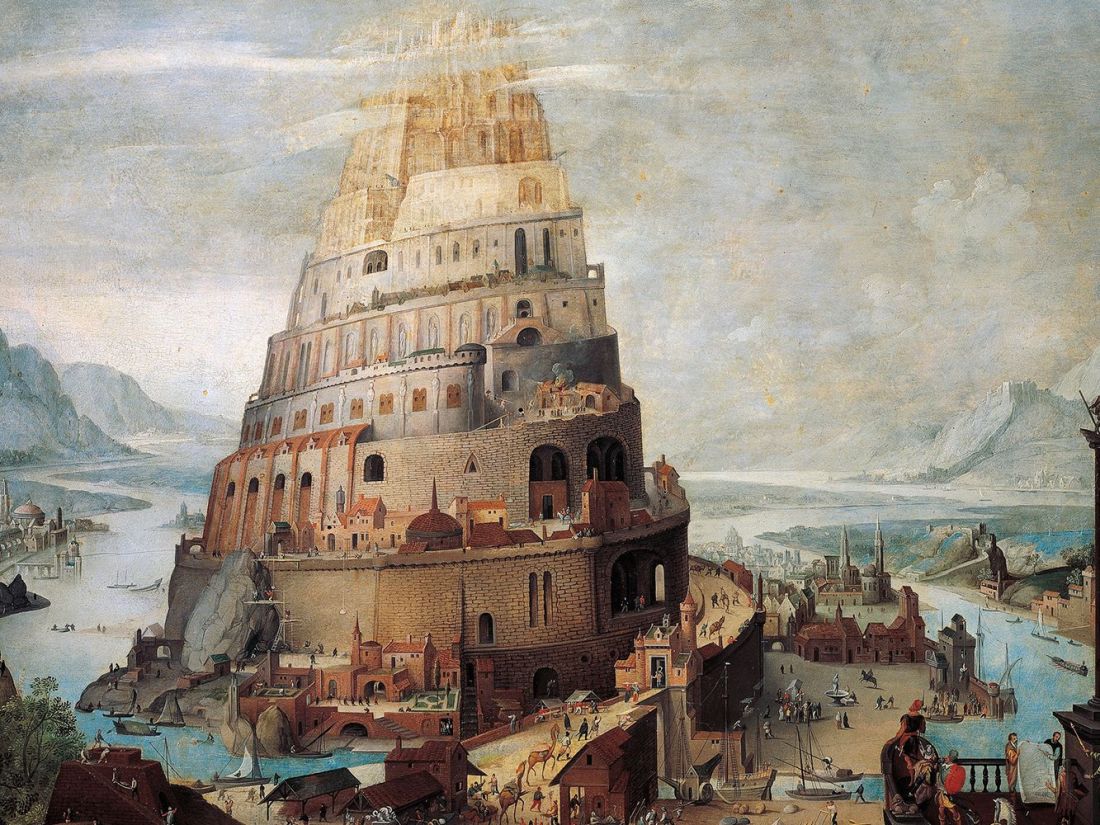
Early in the Bible’s narrative, the people of the Earth decide to build a tower to the heavens; a monument to human prowess and superiority. This was an act of pride, and God frustrated it by causing the many people to then speak in altogether different languages, so that the communication and teamwork necessary to build their monument were no longer possible.

Not only is this a great reminder of the majesty and power of God, but it shows us something rather wonderful about human language. The variety of human language, being the punishment for the Babel building project, is a result of sin and the curse. Consider that. Until that moment, ‘the whole Earth had one language and the same words’ (Gen 11:1). So, should we think of languages as a dirty and profane thing, since their existence is directly the result of sin? Should we prioritise one language above all, and try to erase the differences and cause all the world to speak one language? Now, apart from the fact that it would be English, (let the reader hear us smirk), it seems that autumn leaves and Pentecost both have something to teach us here.

This author does not pretend to know how cell decay/renewal and ecosystems worked in the garden pre-fall, but we hope that it is a fair suggestion to say that the cycles of death and life that are essential to our world (such as the seasons, and the way that decay is part of the process of growing) are a result of the fall, if the premise is sound that death of that kind was not around pre-fall.

So, if we can grant that seasons are downstream from sin, at yet we glorify God by studying the intricacy and beauty of the seasons, from the first buds of spring to the fall of the autumn leaves, we must conclude that God wields history and providence in such a way that our mistakes only give him more opportunities to show his genius and reflect his beauty. It’s almost like he planned it that way.

Back to languages. This author is deeply fascinated by grammar and syntax, by the way that the words we have available to us shape our ability to think. If you don’t believe us, ask Yeonmi Park or Winston Smith. Praise God for the earthy oddities of the Hebrew language, its poetry that is beautiful in any translation. Praise God for Spanish, for its faithfulness to its letters, its pleasing cadence and rhyme which follow from its grammatical gender system. Praise God for Polish—give us a second while we pretend to be unbiased—for its insistence upon oral gymnastics. (Here, just look at this tongue twister: W Szczebrzeszynie chrząszcz brzmi w trzcinie) , and its cheeky attempts to get away without vowels (wszyscy). Consider the phrase ‘Jesus is Lord’ in various languages: المسيح هو الرب, 耶穌是主, 예수는 주이다, यीशु प्रभु है, ישו הוא אדון.

You don’t need to be able to read that to appreciate the beautiful variety of human language. What’s more; the mouth, tongue, throat and lungs can be trained in such a way to produce all of those sounds, and to do so consistently to the point that other people can understand. It’s incredible. Just listen to music in another language for a few minutes, or watch two people flirt in another tongue. Listen to an argument or try to pronounce a few words in your friend’s language. God made all of them, he brought all of that beauty from sinful actions. This is a key theme in Scripture, the idea of the Felix Culpa, the fortunate fall. The Final State will be immeasurably better than Eden, and so whilst we never encourage sin, we worship a God whose grace is bigger and stronger than our sin, and whose grace always has the final word.

There’s an interesting parallel to Babel in the New Testament: Pentecost. It is this glorious and exciting moment where the Spirit gives the church the ability to speak other languages known to man, and He does so for the sake of Evangelising and saving them. God scattered the people across the Earth and confused their language at Babel, and at Pentecost he began the process of uniting us. However, did you notice, Pentecost didn’t just make everyone speak Aramaic or some local Semitic dialect? As the Spirit empowers his people to bring the gospel to the world, he doesn’t turn everything into one big average bowl of grey mush. He keeps languages distinct. He doesn’t dissolve cultural and ethnic variation, he redeems it. So clear is this, that in the Apocalypse to John we see “a great multitude that no one could number, from every nation, from all tribes and peoples and languages, standing before the throne and before the Lamb” (Revelation 7:9a, emphasis mine).

So trust God. When you mess up, as you know you have, and as you know you will, trust that he is not only mighty to save, but that he’s also redeeming the messes you make. The same God who turned sin into seasons, who brought forth vernacular from vanity, is the same God who will save you to the uttermost if you throw yourself today at his feet, and trust only in his finished work for your redemption. Then with this author, look forward to the day that you will be counted among the number of his elect standing before his throne, joining in the heavenly chorus of “Holy, Holy, Holy is the Lord God Almighty, who was, and is, and is to come!”

Chronological snobbery and facts about leather

It has been well said that we live in consumerist culture, where not only possessions but interactions are conceived in a ‘transactional’ manner, and that in many facets of life we have come to think of ourselves as customers. In response, many an institution has treated us that way, and they have asked themselves what they can do to interest us in their product, whether it be food, literature, cars or phones. These days, even banks and superannuation funds try to sell you some high ethical ideal, or the impression that they care about your wellbeing!

It seems that every year, we get a new version of the thing that was new last year. A new iPhone, a new Mustang GT, a new action movie in which Liam Neeson plays Liam Neeson, even a new burger at McDonalds, and then an even newer one at KFC, the superior fast-food outlet.

Jest aside, and now more seriously, we also are constantly met by new teaching, new ideas about God, new fads of theology and the Christian life. Some of these are harmless, and merely represent the church faithfully responding to cultural fads with the light of the gospel, but sometimes a kind of syncretism sneaks in, where the fleeting and temporary things which are prized in society are mixed in with the gospel to make it more attractive, and in doing so, pollute it, causing it to be no gospel at all. So, it happens, that subjects that have been handled comprehensively and adeptly by the saints of old, on whose shoulders we stand, are approached anew. The thing is, newer isn’t necessarily better.

This author acknowledges to his own chagrin that it is young people who often assume falsely that they bring superior wisdom to an issue than can be found in the previous 2,000 years of the Christian church. Indeed, novelty is the prized attribute of many things in this day and age. We crave novelty everywhere. That is no problem in the kitchen, or the movie theatre, or the fashion show, but it can be a very serious problem when sought in the Oracles of God.

In a world of planned obsoletion, the world of low-quality fast-fashion is everywhere. We almost expect materials to get worse over time. That’s what’s special about leather. A good leather jacket, or leather boots, may last you decades, or indeed may last so long that you can pass them down to your children. This author is the proud owner of a hand-bound and hand-sewn leather journal, which has such a feeling of autochthony that it feels more like a museum relic or the long lost possession of a bushranger than simply a product one might buy at a vintage goods shop. Everyone recognises this timelessness and quality when they see it in leather, but not everyone, and particularly not all of those who profess faith in Christ, see it in the vast deposit of intellectual wealth that has been left to us by giants of old.

This is the chronological snobbery of which we speak. Few a visitor to Koorong would stop with their attention piqued at seeing the title “Of Temptation: The Nature and Power of It, the Danger of Entering Into it and the Means of Preventing that Danger: with a Resolution of Sundry Cases Thereunto Belonging” on the shelves. Perhaps John Owen could have taken on some constructive criticism about how to title his book, but what gold mines we ignore because they sound or look old-fashioned!

A certain bald man who has an affinity for Coogi sweaters based in Tempe, Arizona, once made the comment that ‘Calvin smudges’. This is a reference to the old mechanisms for printing in which excess ink could cause smudging on a page if it wasn’t given enough time to dry before being placed in a pile. The reality implied is that his words are still so hot off the press, as it were, that even today they smudge on your fingers as if they had just been printed today, such is their timeless accuracy. Though having read only a small portion of Calvin, this author can attest that his words have not faded. Let us here make recommendations for a few books that were not written recently, though deserve to be published and re-published and prized more highly than the novelties of the day. Knowing God – J.I. Packer, Holiness – J.C. Ryle, The Pilgrim’s Progress – John Bunyan, and finally one that we admittedly have not yet read, though have good reason to believe is still tremendous in its insight, The death of death in the death of Christ – John Owen.

Dear reader, treasure the fine things that have gone through the furnace of time, and emerged timeless. Don’t be afraid to go out of fashion, for fashion is like a boat tossed by every new wind and wave. Cling to the truth that will never become outdated, and never need revision. Cling to the cross, and find there a perfect saviour.

Fiction break: An introduction to the Parable of the Library

Recently, I wrote a really fun short story called The Parable of the Library, and you can read it here.

This story is a combination of a few ideas, and draws on a number of literary influences. I have recently read (and greatly enjoyed) John Bunyan’s The Pilgrim’s Progress, and I now fully understand why it was one of the most influential books of the 17th century, and the second most widely translated and published book after The Bible itself.

Reading it in its original old-English style, it had a very charming and whimsical nature to it, whilst still being an unbelievably stirring and relatable account of the Christian journey through the strife of this world to eternal rest and company in the King’s house.

Bunyan’s novel is an allegory, where every character’s name is what that character is. For example, Pliable is the easily swayed friend of Obstinate, who is a stubborn man that does all he can to convince Christian to give up his pilgrimage. What is happening there is that the author is admitting something to the reader, saying, “Yes, this character may seem predictable and one-dimensional, but he will teach you something harrowing about the manifold wickednesses of this world and its fallen people’.

The drama in Pilgrim’s Progress is not riding on nail-biting and fast paced prose, like a Matthew Reilly novel, but rather on the devastatingly accurate insights provided to the reader by watching foil characters such as Mr Worldly Wisdom and Giant Despair with his Doubting Castle show the deep inadequacy of Christian and his friend Faithful, and their deep reliance on God’s word and Providence.

Before I connect that back to the Parable of the Library, a quick word on Children’s Literature. I had the pleasure of studying one unit in children’s lit during my time at Deakin Uni, and I actually learnt a lot about the surprising depth and maturity that children can handle–and perhaps even require–in their literature. In fact, whereas YA (Young Adult) prose tends to read like normal speech, or like normal storytelling (albeit with more love triangles, where the young lady always has to choose between the Nice Guy or the Bad Boy, than appear in real life), children’s lit has the multi-layered task of being a visual and textual medium, whilst also having a style of delivery that is markedly different from normal prose.

Though it is easy to trivialise or look down upon the rhymes and repetitions of picture-story books, there is truly a poetic quality to much of this writing–or at least the best examples of it. The writer of children’s lit has the freedom to repeat something in a manner that would be decidedly foreign to common parlance, or to sit and remain on one detail at such great length that in any other setting one’s editor would be going at it with her big red pen.

The final main literary influence to this story in terms of atmosphere and absurdity is Dostoyevsky’s Crime and Punishment. This classic has a frustratingly large number of characters who rant and rave, forsaking all semblance of logical flow or courtesy to go on and on in exhausting tirades of introspection. After a few hundred pages of characters at the end of their wits, constantly wringing their hands in shame and beating their chests in sorrow, the reader can start to feel a little loopy, like nothing in Dostoyevsky’s world makes sense anymore, or like none of the characters can be expected to act like normal humans. Dostoyevsky was masterful at creating and sustaining an atmosphere of sheer frenzy and absurdity, where everyone’s eyelids are pulled back and you feel as if you are staring right into their bones. It feels like the trials in The Crucible or the Jurors’ discussions in Twelve Angry Men, or perhaps Marlow’s terror in Heart of Darkness.

So, with the tastes of those books lingering in my mind, I found myself eager to write an allegory of my own. Due to a funny thing called Presuppositonal Apologetics (if you are a Christan, you simply must learn about this), I found it odd to watch non-Christians borrow concepts from the Christian worldview like Truth, Value, Meaning, Beauty and Justice and yet reject the Christian worldview that is solely capable of providing a rational and consistent basis for those ideas. I thought, ‘wouldn’t it be intriguing to discuss the borrowing of those ideas as if they were library books?’ With that, The Parable of the Library was born.

I would be greatly honoured if you, mostly highly esteemed reader, would read it. It was fun to write, and I hope it will be fun and provoking to read.

Thank God you’re here! The life-giving blessings of Ordinary Providence

One curious thing we see in Paul’s letter to Rome is that failure to honour God and failure to give thanks to God are the two failures he mentions when explaining what caused the futility and depravity of mankind, and God’s subsequent deliverance of mankind over to their lusts and impurities and idolatry. Failure to give thanks!

Ever since this author really came to grips with that text, the element of gratitude and thanking God became prominent in ordinary daily prayers.

Let us think for a second about the time in which we often thank God. There’s dinner time, where some families say grace before eating. In North American families, there’s the Thanksgiving holiday, in which (we imagine) Christian families would direct their thanks to God. Observation suggests that God’s affirmative response to our prayers, especially in the manner and timing we were hoping, also elicits much gratitude, but otherwise giving thanks is largely not seen as the main feature of either our prayer lives or our communion with God.

We mentioned this in our article on Gnosticism and Christian Hedonism but only briefly. To quickly summarise one of those points, thanking God for ordinary physical things like nice clothes and good food and enjoying them to God’s glory is a performative refutation of gnosticism, because it elevates the value and significance of mere material things, shattering the false dichotomy between spiritual-valuable and physical-worthless.

Building an ‘attitude of gratitude’, as the youngest son of this author’s parents put it, is a truly life-giving blessing. You will have a hard time fretting about a million things that haven’t gone your way and your inexhaustible list of things God should do for you if you consciously decide to thank God for everything you can think of—and why stop there?

You only have so many hours per day, and the information you choose to fill your head with is really your call. Whatever it is, it will disciple and train you. Will you use your time and attention being conformed to the image of God’s son, or being discipled in the desires and fears of your culture? This is not something you can opt out of. It is not whether you will be discipled, but by whom, or by what.

We digress; the point is this. If you learn to slow down by itemising and counting the things God has done for you (or should we say, the things God has done for you that you are aware of), you will see how progressively bigger and more gracious he appears to you, or as Beautiful Eulogy put it,

“When Jesus Christ becomes progressively bigger, or better yet, your understanding of who he is progressively conforms to reality, your faith will become increasingly stronger.” (Devotion – Worthy)

Ok, let’s get down to the meat and bones. Try this. Pray in gradually widening concentric circles. Start by thanking him for how he made you, warts and all. Thank him for your family, your friends, your communities and the places you feel safe. Don’t rush this. Say their names. Picture them. Enjoy the memories, all the while thanking him.

Thank God for hard lessons you’ve learned in grief, loss, failure, in your sin and repentance. Thank him for the things he’s doing that you don’t know about. There’s a lot of them, believe it.

Get creative. when you see an animal you like or a flower you like, or architecture that you find so pleasing, or a pleasant cloud, stop and thank him for it. He designed it, and how well at that! keep in mind, he is the author of history, so he intended that you would be blessed by this thing you have just thanked him for.

Additionally, of course, thank God that you’re here, which you still are if you’re able to read this. Though this author doesn’t exactly know who is reading, he is most exceedingly glad that you are indeed here. Praise God!

Finally, and this one might require you to sit down, or brace yourself, all Providence benefits the elect where it matters, so you should learn to thank God in things that suck, because he puts you in them so he can bring you through them. Notice we say thank God ‘in’ things that suck, not ‘for’ things that suck. The distinction is this. If a wicked and sinful thing is done against you, it is not the sinful action that you appreciate or are grateful for. It is the God who is sovereign that you are grateful for. It is the fact that ‘this light and momentary affliction is preparing for us an eternal weight of glory beyond all comparison’ that should give us a gritty but glowing hope. It is the fact that he doesn’t make mistakes, and that it is for your good, and his glory.

If we, as cushy and comfortable Western Christians are to be prepared for the persecution and trial that has been the experience of God’s people throughout history, we must be furnished with a strong faith. One that, should our family die in a naval accident, could pen ‘It is well with my soul’. One that, should our blessed freedom vanish like a mist, will be prepared to stand for Christ, even unto death. It all begins with giving thanks.

Analysis – Aftermath (flash fiction)

There’s a style of flash fiction I really enjoy writing, which revolves around two elements: being two to four paragraphs, and being non-chronological.

It’s fun to read, but it’s solving a puzzle as well as reading a story. I like the reader to learn the information before they know the significance. That way it creates this disjointed moment where you realise that a small passing detail was actually the crucial information, the conclusion to the story or a central plot point.

This relies on having a couple of key words that link the paragraphs, and just enough temporal indicators that the reader can piece it back together.

Anyway, I wrote this one ages back, check it out. 🙂

Graveyard evangelism

There are a number of things that graveyards and places of higher learning have in common. One is that there are names etched into walls or plaques, another is that those names used to mean something. The inhabitants of the former are entirely dead in their graves, the inhabitants of the latter are overwhelmingly dead in their sins and transgressions, in which they still walk.

Now, imagine that you had set your mind to evangelising the residents of either of these places. You said your prayers, you stuffed your pocket with tracts, and your bag with New Testaments. You picked a modest but ‘cool’ outfit so that you would seem relatable but not sketchy. You rehearsed your apologetics arguments, all the way from the cosmological argument to the transcendental argument. What do you instantly notice?

Upon reaching the first grave, that of a certain Jorge Mario Bergoglio, you encounter a rather serious problem. He refuses to shake your hand, he does not reciprocate your greeting, he cares not for your comments about the weather, and he shows no interest at all in talking about Christ!

‘Oh my,’ you say, ‘what am I doing wrong? What do I need to do to make this poor Mr Bergoglio a believer?’

The conclusion to this allegory should be by now rather obvious. Jorge does not respond positively to the presentation of the gospel because he is dead. Here we discover what is not the capacity nor commission of the evangelist: resurrection. The evangelist does not have the power to bring dead people to life. We all understand this to be true in the corporal sense, and it is just as true in the spiritual sense. That is evident in Paul’s choice of words. We are not sick in our sins, nor feverish and comatose in our transgressions, we are dead.

Romans 1 adds some details to this plight of the natural man. All people are created with an intrinsic knowledge of the God of the Bible, but all people have refused to honour God and give thanks to him, and as a result, their ‘foolish hearts were darkened’ and ‘claiming to be wise, they became fools’ (Rom1:21b, 22). Sin has had an impact not only on our conduct, making us workers of lawlessness, and on our hearts, making us factories of idols, but on our minds, making our reasoning flawed and foolish. The scope of the human capacities that sin has corrupted is total. That is why some eminent students of the Scripture described the condition of the natural man as ‘Total Depravity’.

Unsurprisingly, our pride rushes to our defense at such an allegation. ‘Totally depraved?’, we object, ‘Why, do you not know that I honour my father and mother, refrain from theft and perjury, and enter not into my neighbour’s wife?’ We mistakenly hear this doctrine as saying that we are as evil in conduct and thought as we could possibly be. That’s simply not true.

The PR team for this doctrine have done a rather poor job, and in our garden of flowers which tell us things about the Scripture, we will replace the T of our tulip with ‘C’, that is, ‘Consistent Rejection’.

Before you ask what we mean by Consistent Rejection, apart from perhaps a description of the love-life of this author during highschool, we will return to the graveyard from earlier, and our dear friend Frankie- oh, I mean Jorge.

The evangelist must learn that the person they are speaking to is dead on the inside. They are not ‘drowning’ as some semi-pelagians would say, nearly dead but retaining just enough capacity to ‘reach out with the hand of faith’ and grasp Christ. They are dead. Hear it from Paul if you will not hear it from us.

For those who live according to the flesh set their minds on the things of the flesh, but those who live according to the Spirit set their minds on the things of the Spirit. 6 For to set the mind on the flesh is death, but to set the mind on the Spirit is life and peace. 7 For the mind that is set on the flesh is hostile to God, for it does not submit to God’s law; indeed, it cannot. 8 Those who are in the flesh cannot please God.

Romans 8:5-8, emphasis mine

Here lies the inspiration for ‘Consistent Rejection’. The spiritually dead person rejects your gospel, because they are slaves to sin, so they freely choose to act according to that enslaved nature. No one has hold a gun to a vulture’s head to convince it to pick at a carcass. It freely chooses according to its nature to eat such things. Likewise, no one has to thrust a lance in the face of a little bunny rabbit to convince it to eat lettuce and carrots. It freely acts according to its nature.

In the same way, a spiritually dead person will freely and consistently reject the gospel. They are a slave to sin, they cannot submit to God’s law nor please him, they are dead.

The reason that places of higher learning were compared to graveyards at the start is that the experience of evangelism at a uni or tafe must be understood as graveyard evangelism, lest it end in discouragement or burnout. If you set out to win people to Christ with your clever arguments, seeker-sensitive attractions or winsome dress and vocabulary, you will quickly find yourself discouraged.

Prayer is your greatest tool in evangelism. Hear us say this, and hear it well. If you are conversing with an unbeliever on spiritual matters, pray in your head to the Lord of hosts that he would bring spiritual resurrection to your interlocutor. This is probably one of the most important things you can do in evangelism, and for two reasons: Firstly, the Lord may grant repentance and faith (2 Tim 2:25, Phil 1:29), and secondly you will learn a posture of reliance on God in the great and awesome work of evangelism.

Finally, the element of your evangelism that must be central and defining is your use of Scripture. Do not fall into some fantastical idea that there is a strong, positive, linear correlation between Scriptures quoted and frequency of repentance that you could use to reliably plot success in evangelism, but there truly is saving power in the words of Scripture (Rom 1:16).

Do not lose the excitement of this truth: when you bring God’s word to a world enslaved to sin, you are making war in the spiritual places, and doing battle with the unseen powers and principalities. You are a common clay jar, but the treasure you carry within you (the gospel proclaimed) is powerful to bring down enemy strongholds (2 Corinthians 10:4) and to raise dead sinners to life in Christ (Eph 2:5).

You might be tempted to think, ‘what could be more discouraging to an evangelist than the knowledge that they are ultimately powerless to save anyone at all?’ However you would be missing the glory. What could be more encouraging to an evangelist than the reality that it is not their performance or practise that determines the salvation of others? What could bring greater reassurance than the fact that despite the field of dead bones before us, God’s work which he has demonstrated and promised to do is the work of bringing people to life (Ezekiel 36-37) and granting them a believing heart?

If you are reading this, and the fear has come upon you that you are dead in your sins, and without hope in your own ability to be saved, it may well be that God has granted you a repentant and contrite heart with which to grasp him unto salvation. Behold the cross, see the saviour killed on behalf of his people. Cast your lot with him, trust in Christ for salvation and as your Lord, and you will find him to be a perfect saviour.

The trees belong to the church

There is a quote attributed to some monk you may know called Martin, though scholars agree he wouldn’t have said it, that goes something like this: “What would I do if the world was ending tomorrow? I would plant a tree.”

It doesn’t matter who said it. The point is this: a tree is an investment in the future. To believe that planting a tree is a good course of action, that it will be productive and that the tree will grow, flourish and clean the air, is to believe that the world will not end next week, next month, or next year. Otherwise, there would be no point in planting trees. Indeed, if the trees will not grow, and the dawn brings destruction, “Let us eat and drink, for tomorrow we die” (Is 22:13b).

Consider a cathedral, or any great feat of architecture in the ancient world. The very tiles and beams are testimony to their belief that their efforts would not be wasted, that there was a future on the Earth that made decades-long construction worthwhile.

At this point, the reader who has studied history may say, ‘but consider this: the ancient Egyptians didn’t believe in your God, they weren’t in your church, yet they also invested in the future’. This is true, but that is why we mention consistency.

As it happens, most worldviews and world religions have an optimistic view of the future. Most believe that their God will win. That their philosophy will eventually dominate. Even the socialists believe that, and they’ve had time after time to prove themselves wrong! In fact, the reason that the Taliban have just retaken Afghanistan is that they have an optimistic eschatology. They believe that the world will one day all be under submission to the god of the Qur’an. The actions of (what we call ‘extremist’) Muslims in fact demonstrate faithfulness to their prophet and their authoritative texts. They are willing to put their money, their lives, their women and their children where their mouth is, because they believe their texts, and their actions accord with their beliefs.

So, there are worldviews with optimistic eschatology, some of those have adherents whose actions accord with such optimism, but only one worldview has also truth that warrants such belief.

It is the self-revelation of the Triune God of the 66 books of God-breathed Scripture alone that gives the Christian the warranted confidence to say, ‘I will plant these trees and make investment in the future, because Christ wins, because my body is not destroyed but raised, because the wealth and glory of the nations will be redeemed for his glory, because the gospel will spread through all the nations and win them over, and because we still have a long way to go, and my great-great-grandchildren will need a garden in which to read Scripture and sing Psalms.

Nothing in this life is ordinary, or insignificant, or outside of Christ’s Lordship. Everything we do should be consistent with what we believe. Mr and Mrs Christian should do all things to the glory of God, and with their eyes set high to highest heaven, and far to the distant reaches of time. It may well be that the saints of 2021 will one day be grouped in with Augustine, Jan Hus and Tyndale as being all part of the early church.

In that day, may there be a house of timeless beauty built for the saints to gather for Sunday worship, and may there be one in every state, every neighbourhood and every suburb. May there be forests of trees, standing for centuries, with rings to attest their planting in the year of our Lord 2021. May we eat good food, drink clean water and be prosperous and multiply, filling God’s creation with his Image-bearers. May we not fear the false eschatologies of man, whether Islamic, eco-fascist, climate-alarmist, cyclical or the so-called ‘heat death of the universe’.

So plant a tree, and thank God for the trees. Thank God for trees that will be planted in twelve-hundred years time or four thousand year time, if the Lord should tarry. Above all things don’t give way to fear and resignation. The story is not over. Nor will it end badly. No, it will end with the hero slaying the dragon and getting the girl, and the trees will all clap their leaves in praise, even the very ones you planted.

The shifting goalposts of a poorly-written story

It has been well said by a certain Canadian that people do not receive life as just raw data, as just plain facts, but as story.

This author must agree, and given his penchant for narrative, feels some evaluation is in order for the story we are currently participating in. More accurately, though, we should call it the story that is being told about what we are participating in.

This story had some real potential from its opening pages. There was a murky and villainous threat affronting us, in the form of an unknown and deadly virus. The protagonist of this story was made to be us, the people, the nation. Our call to action sounded something like this: ‘15 days to flatten the curve’. Like a brave but under-resourced rag-tag bunch of grizzled warriors, the story went that the whole country would likely be overrun by this plague, and the best we could do was slow it down so that as we all needed a run in hospital, we wouldn’t overwhelm the system.

Admittedly, this created a rose-tinted camaraderie as many of us felt a sense of unity in what would be our common struggle. There was also some comedic relief as we ran out of toilet paper… The complication that had been built was about hospital beds and infrastructure, and we received regular updates about how we were going. The story unfolded before our very eyes, and to crank up the scale, this same quest was being faced all around the globe, nation by nation.

However, then we, the engrossed reader, found that something odd happened. The quest changed, but the narrator didn’t skip a beat. The reader was staring keenly at the page, to see if she had accidentally skipped from page 34 to 37, missing 35 and 36 like those thin bible pages that are so hard to separate. However, that was not the case, but neither did it seem like a big deal. Just a plot development, or perhaps a twist?

Some readers at this stage put the book down, because they had their hearts set on the resolution that was implicitly promised to come at the end of fifteen days. Other readers found that the most enjoyable parts of those fifteen days were the last three months.

All things being equal, the story had become one about cases. We, the nation, were still the protagonist. We had our Ben Kenobi type character (a character of assumed authority who in both cases had more or less no prior influence or authority in our lives) advising us how we should complete the quest. We had our words of wisdom, and our amulets against the evil adversary. ‘Stay safe, stay home’ we would echo in solidarity.

For many Victorians, there was a deeper level to this part of the story, which we have previously analysed in The sacrament of vaccination. At this point in the story, two essential things changed, and one of those was the end goal. Imagine if, when watching ‘The Castle’, Darryl Kerrigan quietly decided that he was now in fact fighting for a ‘new Castle’, which functionally meant living in an RV, because the complication in his story was so great that defending his castle as it used to be was just unrealistic. That would be a disaster, and no one would watch it.

This was one of the errors, seen in the soggy disappointment called ‘new normal’. From the start of the story, the protagonist was convinced that he or she was fighting for ‘back to normal’, not ‘whatever we decide to call normal at the end of the story’.

The most essential goalposts had shifted. The reader had already the early onset of a frown from the plot change from ‘15 days to flatten the curve’ to tracking cases, then hospitalisations, then deaths, then people coming into contact with one another, then vaccine development, then vaccine production, then vaccine availability, then vaccine options, but now the full wrinkles of a scowl were developing as the very motivation for questing had dissolved into the mire of PR and terminology. If this story wasn’t going badly enough, we shall turn our eyes to its next great blunder, as aforementioned.

There was a most victorious time, a splendid tranquility which in normal genre fiction is called ‘the end of the story’ or ‘the resolution’ or ‘darl, can you return this one to the library now?’ However, as if starting the sequel film as the patrons were leaving the cinema, or as if including in the first book the first two chapters of the second book, the protagonist discovered that the end state they achieved was not in fact a resolution.

To be clear, this was when the ethically bonkers strategy that got us to zero cases fell apart as soon as international travellers entered the country. To the reader who dismisses this allegorisation to story form as unfounded, do not be so quickly sure of our folly. The narrator, who in this case is being played by the mainstream media talking heads, had made a critical error in storytelling, and now cannot be trusted to get their story straight. To be frank, they told us a bad story, and a false one at that.

Admittedly, the narrators didn’t actually know where the story was going, or how it would resolve, or how the protagonist should solve it, or who the real protagonists were, so that did complicate things for them. They were attempting to cook us a barbeque, and were only missing the sausages, the burgers, the olive oil, the onion, the tomato sauce and mustard, the bacon, and the barbeque- but they made sure we had beer and deck chairs.

This is a call for honesty. It’s ok for the narrators to admit that they aren’t actually narrators, but fellow adventurers with us on the quest. If the news media wants to claw back even a skerrick of authority or reliability, those entities need to repent of their constantly failed attempts to sell us a story they aren’t writing, and don’t know.

Finally, this is an exhortation to optimism and hope. The one who actually wrote the story, who truly commands the flow of time and the passage of history, has written every detail beautifully and perfectly. The fact is that there is victory in history for the True Protagonist, King Jesus, and for all who trust in him, because our story started before the world was made, and will continue on into everlasting upon everlasting.

For you formed my inward parts;

    you knitted me together in my mother’s womb.

I praise you, for I am fearfully and wonderfully made.

Wonderful are your works;

    my soul knows it very well.

My frame was not hidden from you,

when I was being made in secret,

    intricately woven in the depths of the earth.

Your eyes saw my unformed substance;

in your book were written, every one of them,

    the days that were formed for me,

    when as yet there was none of them.

Psalm 139:13-16

Once Saved Always Saved: Because God is faithful

For R.A., in the knowledge that he will one day understand, and in the hopes that it will be this side of glory.

As a preface to this doctrine, we must keep in mind an important reality. The human heart is desperately wicked (Jer 17:9), and we have trouble believing or accepting teachings that don’t put us at the centre, but rather God. As we dive into this doctrine, we will discover that it is like a beautiful tulip surrounded by a whole flowerbed of doctrines that are hard on human pride and ego. In fact, the reader may be familiar with two petals of the same flower which we considered many months ago, namely, The importance of Hesed and Complete Atonement, briefly.

The biblical truth we are defending today is the reality that once a person is saved by God, God is faithful to preserve their faith until the final day, and they can never fall away, be lost, become unsaved, go to hell, or however else you’d like to say it. This challenges our mankind-centred way of thinking, which is seen in the most common retort offered by the Remonstrant Christian, “what about people who stop believing?” Hear this, because the following is the centre and core of the matter. It’s not about you in the first place. It’s not about your perseverance in faith and holiness, it’s about God’s preservation of his people.

Before we start planning how big the garage should be and whether or not the master bedroom should be north-facing, let’s lay a foundation. Before a person is saved, that is, before a person becomes Christian, they are ‘dead in their trespasses and sins’ to use the language of Ephesians 2. You might think to yourself, “that’s odd, the cashier at Woolies today was certainly a Hindu man, but he appeared to be alive, at least to my untrained eyes.”

That’s true, and when Paul wrote those words he had in mind a spiritual deadness. He goes on to explain that because of God’s kindness and love, he acted unilaterally to move the non-Christian from a place of spiritual death to spiritual life.

“But God, being rich in mercy, because of the great love with which he loved us, even when we were dead in our trespasses, made us alive together with Christ”

Ephesians 2:5a, emphasis mine

This is a monergistic work, meaning that only one party was acting to bring this about, and that is God. Incidentally, that is why a Christian can say ‘Jesus saves’, and not just ‘Jesus tries to save, or at least does his part, but he needs you to say yes for it to work’. See, The importance of Hesed.

As the concrete dries, let us summarise where we are at. Making (spiritually) dead people (spiritually) alive is something God does by himself and for himself because it is his nature to be merciful. A person believes in God because they have been brought to life (Ezekiel 37) and had their eyes opened, they have been granted to believe (Phil 1:29).

As we consider the floor plan, we must consider the three tenses. God saved us, is saving us, and will save us. That is, in eternity past he specifically chose certain people to be saved and come to know him (Eph 1:4-5, Rom 8:29). In the lifetime of those elect people, there is a decisive moment when they are saved, as discussed above (Eph 2:8-9, Rom 10:9-17), and in the future until the final day, those people will be saved (Phil 1:6, Rom 8:30). We are chosen in eternity past, regenerated in time, and saved until the last day.

If you would permit the author to continue dealing fast and loose in allegories, we shall make a trip the cinemas of the near future. Bob and Jane both have tickets to see Fast and Furious 15, which they decided sounded more appealing than the 35th James Bond film. As they approach the bored-senseless 15-year old who is being paid far too little per hour, the reason he permits them entry into cinema 5 is that they both have a ticket each. If a scheming mob were to rob Bob of his ticket, or if Jane came by train and left her ticket on the seat, they would not be permitted entry. If Bob came back the next day with thirty-seven tickets, but then proceeded to sell them all to Smiling Sam, then, yeah you get the picture, no film for Bob.

Now switch it up. The film is hell (this may be true, in hindsight), the ticket-guy is God, and the tickets are your account of sins. You rightly go to hell if you have even one ticket, even one sin. However, if all of your sins were taken from you on the way in, as with Smiling Sam, then there is no way for you to enter hell.

A saved person has all of their sins for all time paid for. That means that there is nothing in the universe that they could be guilty of that would give God cause to send them to hell. The atonement for that person’s sin was definitive, perfect and complete. To say that a saved person could enter hell is to say that Jesus’ work on the cross wasn’t good enough, it is to say that he couldn’t quite pay the price. The instinctive retort here is usually, ‘but what if they turn and hate God, and sin against him, then they’re not going to hell for the things Jesus already forgave but for the sin of unbelief and rebellion!’ However, this misses the fact that a saved person has all their sins paid for, whether past, present or future. It would once again be the position that Jesus failed to pay for all their sins. Such a reply is not just nearsighted, it is even arrogant. For if by one’s rebellion and unbelief one could remove themselves from God’s salvation, what makes you think you wouldn’t fall? Do you really think you would maintain a level of faithfulness to God such that you would not fall away? If apostasy of this kind were possible, we should admit that all people would fall prey to it, including this author, and the esteemed reader, if he or she be a follower of Christ.

When we talk about Jesus ‘paying the price for our sins’, we ought to be more specific. He took the record of sin from all of the people his Father had chosen to save, and when his Father crushed him on that cross, Jesus was a sacrificial lamb, just like the lambs that God’s people had been offering for countless years. However, his work didn’t end there.

“But when Christ had offered for all time a single sacrifice for sins, he sat down at the right hand of God, waiting from that time until his enemies should be made a footstool for his feet. For by a single offering he has perfected for all time those who are being sanctified.”

Hebrews 10:12-14, emphasis mine

If your eyes have started to glaze over, pay close attention here: see the effect of Jesus’ offering. Jesus’ sacrifice has perfected for all time those are being sanctified. In other words, Jesus’ sacrifice has already sealed the deal on salvation for all the people his Father gave him. There’s no question, Jesus already locked in and guaranteed the salvation to the end of all who he will draw to himself. This verse by itself is a sufficient argument against the Remonstrant, but we shall nevertheless press on.

“The former priests were many in number, because they were prevented by death from continuing in office, but he holds his priesthood permanently, because he continues forever. Consequently, he is able to save to the uttermost those who draw near to God through him, since he always lives to make intercession for them.”

Hebrews 7:23-25

Look at the logic in that passage.

  1. Jesus is a priest who intercedes for his people.
  2. Jesus holds his priesthood forever since he never dies.
  3. Therefore, Jesus will always be interceding for his people.

The confidence that a Christian can have comes from the fact that Jesus presented his own sacrifice to his Father, and his Father was satisfied. Regardless of a person’s constant second-guessing of their salvation, regardless of the lies that the Accuser would bring before God the Judge, Jesus is always there for his people, pleading their case to his Father, and because of his perfect sacrifice, the Father will always hear his Son and grant forgiveness.

“…If God is for us, who can be against us? He who did not spare his own Son but gave him up for us all, how will he not also with him graciously grant us all things? Who shall bring any charge against God’s elect? It is God who justifies. Who is to condemn? Christ Jesus is the one who died—more than that, who was raised—who is at the right hand of God, who is interceding for us. Who shall separate us from the love of Christ? Shall tribulation, or distress, or persecution, or famine, or nakedness, or danger, or sword?”

Romans 8:31b-35

This should knock your socks off! This should blow your fuse box! This should have you going ‘say what now?’ and ‘oh no he didn’t!’ Christian, look at the confidence you can have in your saviour! There is no one who can bring an accusation against you, even though Satan tries to.

To say that a Christian could one day be condemned to hell and separated from the love of God is to say that Jesus failed to intercede on their behalf before his Father, or that the Father beheld his Son’s sacrifice and was not satisfied. It is taking Paul’s jubilant list of trials that cannot separate a Christian from God and say, ‘ah, unbelief is not on this list. You must have missed that, Paul, for unbelief can in fact separate you from the love of God’.

God’s nature prevents him from lying or from failing to do that which he has promised and decreed. It is God’s will that all those whom he gives his Son should be saved, and raised on the last day (John 6:44). To flesh that out for a second, before God made anything, and before any people could do anything right or wrong, God chose to give certain people to his Son that his Son should save them. Also those same people, every single one of them, even the ones with six toes or different coloured eyes, even the ones who can’t remember when to use ‘there’, ‘their’ or ‘they’re’, will all be raised at the last day (in victory, with Christ). The Son always does the father’s will perfectly (John 6:38-39). For a saved person to not be raised on the last day would mean a failure on Jesus’ part to complete his Father’s instructions, and a nullification of God’s promises to those people.

Jesus’ preaching has a deeply pastoral element to it. Also, it assumes a mixed group of listeners: elect and non-elect, and of the elect regenerate and unregenerate. When preaching to a mixed group, obviously Jesus isn’t going to say, ‘Ok this is to only the false believers among you. True believers, you can tune out for a second’ or ‘Ok now I’m talking to those of you who are elect but aren’t yet Christian’.

No, that’s absurd. When preaching to a mixed group, it only makes sense to warn them of the very real possibility of damnation. Some among them are elect but at that stage still dead in their sins. Those people are, at that moment, heading down the track of the damned. Some are false believers, like the second and third seeds in the parable of the sower (Mark 4:1-20). They, falsely thinking they have security in their false faith, need to hear Jesus’ words of warning, though they ultimately will not heed them.

The reprobate will not have ears to hear, and he won’t hear. The elect person will either at that time, or at a time in the future, hear the proclamation of the gospel and the reality of damnation and repent (John 6:37).

This is all to say that Jesus teaching about the reality of damnation to his followers does not mean that those truly regenerate elect followers of his could ever be damned.

The writer to the Hebrews does the same thing, exhorting those Christians to whom he was writing against returning to temple worship, for some of them may well have been false brethren, reprobate men and women who were only following Jesus a short time; while others of them are in view in the author’s heart when he says “in your case, beloved, we feel sure of better things”. Lest we too quickly skip past this beautiful truth, let us treat it like a great work of art we seek to better understand, and behold it for a moment.

The writer to the Hebrews was clearly addressing a mixed group. Through and through, Hebrews is a sermon exhorting troubled followers of Christ to stay true, run the race, and finish with flying colours. However, it is not unreasonable to suggest that a good number of those addressed would have failed to heed these words, and buckling to the cultural pressure, returned to temple worship (which, by the way, proves that this letter was written before 70 A.D.). Even the author understood that some would hear the words and fail to heed them, whilst others would hear this rebuke and stand firm in the faith. All of these people would have made a profession of faith, and called one another Christians. However, it is clear that those who returned to animal sacrifices were not truly Christian. Back to our quotation, the writer recognises that the true Christians amongst those people, the fourth type of seed to use the language from Mark 4, whom he affectionately called beloved, would hear the exhortations against falling away and heed them, run the race, and be welcomed to heaven after their last breath.

Parables serve this same purpose. Jesus teaches in parables to both his disciples and others as we see explicitly in Mark 4:1-2, though on some occasions he explains the parables solely to his disciples, because they have been taught explicitly about the Kingdom of God, “but for those outside everything has been given in parables” (Mark 4:11a). Jesus tells stories wherein the fruits of faithfulness are rewarded and the fruits of unfaithfulness (to put it broadly) result in various judgements (Matt 13, Matt 18:21-35, Matt 25:1-30). Let’s take the parable of the servants in Matthew 25:14-30. The master of the house entrusts three ‘servants’ of his house to steward his wealth while he is away. He gives each of them enormous amounts of money. One talent is, according to my rough calculations, worth the equivalent of AUD $120,000 in today’s economy. He gives one servant five talents (roughly 600k), and another servant two talents, (240k), and the last, one talent (120k).

At the end of the parable, we see that one of these servants did not honour the privilege and responsibility that his master gave him, and he is revealed to be a wicked servant. He is cast into the “outer darkness. In that place there will be weeping and gnashing of teeth”. We have heard some make a challenge along the following lines: “you see here that you had three servants who were with their master in his house. Two are faithful, one isn’t, and he’s cast out of the house into the outer darkness. What more evidence of a person losing salvation do you need?”

There are many good responses that could be made to this type of Remonstrant, but we shall consider the foremost objection that should be sustained, and that is one of author’s intention.

When reading any passage of Scripture, it is proper for the astute student to ask herself, “What is the author trying to convey here? What is his main point? Also, to whom is he speaking?” A section of Scripture that was intentionally and primarily teaching on a certain topic would be the foundational text whereby you interpret other off-hand references to the same doctrine in other places. For example, the fact that the parable of the talents happens to include references to slaves/servants is not to be read as Jesus endorsing the practise of chattel slavery and human trafficking. The point of the parable was about stewarding faithfully.

So, in the same way that one could dismiss outright the question about slavery, since Jesus is not teaching about it in that parable, we could simply dismiss this objection as being outside of the purview of this parable. However, we will do one better and return to what we were just saying.

The first response is one of foundational texts and secondary texts. The foundational texts for our doctrine of salvation and perseverance in Scripture are those that are explicitly written concerning those topics. This is a basic principle of systematic theology. We have already seen a number of texts that are directly and intentionally talking about how a person is saved, what the grounds are of their continued confidence and assurance, and based on what realities a person can expect to persevere in faith until the final day. In short, John 6, Romans 8, Hebrews 6-10 et al are the foundational texts that speak clearly on these topics, and any off-hand references to a person who appears to be a faithful servant of their master but ends up being cast into judgement must be interpreted in light of those texts.

This doctrine can only be properly understood in the context of its flowerbed. If the Remonstrant Christian pointed to the wealth of texts that echo the idea that ‘the one who is faithful will be victorious’ and then said ‘see, it offends reason to suggest that a person cannot fall away, since if they walk in lawlessness the rest of their days, they will clearly not be saved’ then they would be misunderstanding the foundations upon which this glorious doctrine of God’s faithfulness is built.

See, a person will always freely act in accordance with their nature. This means that an unregenerate person will persist in lawlessness and unbelief unless God intervenes, and it also means that a regenerate person will grow in Godliness and conformity to Christ Jesus, because the Holy Spirit of God himself is at work to make sure of it. If a person persists in unbelief and rebellion, it is not evidence that the Holy Spirit gave up or could not overcome that person’s hard-heartedness. No, it is evidence that the Holy Spirit never indwelt that person to begin with. Ok now, take a breather, don’t get mad. Before you insist that this is cruel or unloving, consider what the opposite would be. Under the New Covenant, the Holy Spirit will never fail to conform a regenerate person to the image of Christ. That is his job. To suggest that a regenerate person under the New Covenant could at some time fall away into lawlessness and be damned is to allege that the Holy Spirit, God himself, can fail to achieve his purpose, all because of some sinner.

There is one caveat that must be explained clearly. We abhor the ‘easy-believism’ that has arisen among you, and will arise. It is both false and foul to suggest that a person can ‘make a decision for Christ’ at a youth rally at the age of 13, and having subsequently signed a Bible to remind them of their conversion, could live the next 80 years in rebellion, unbelief and idolatry, and expect to be saved. No, as James rightly said, faith without works is dead. As the Lord Jesus said, you will know them by their fruits. It is not good works by which you grasp Christ, but faith. However, if your faith does not produce a life of Godliness and sanctification, then you have no faith at all, and can only expect to hear ‘I never knew you’ on that day.

Gentle and esteemed reader, we exhort you to hear the Good News that Christ has conquered death, and that through him and him only can you have life. Real life. True life. Believe on the Lord Jesus, be obedient to his commandments (Matt 28:18-20), and walk in the confidence of knowing that your God will never leave you or forsake you, and will most certainly never fail to pick you back up and dust you off when you make a mistake.

We shall throw down the gauntlet, as we are wont to do. We are persuaded that this doctrine of God’s faithfulness to preserve his elect people is more clearly revealed in Scripture than even the doctrine of the Trinity, and perhaps equally as prevalent as the doctrine of justification by faith. We maintain that rejection of this doctrine is then likely either (a) traditional or (b) due to a faulty hermeneutic, since it is no less than absurd to say that the Scriptures do not mention it.

“Give thanks to the Lord, for he is good,

    for his steadfast love endures forever.”

Psalm 136:1

The Art and Soul of Education

What are the prerequisites for an Arts degree? A young year 12 student asked this question, and his friends gave him various and sundry answers, some of the highlights being ‘a coffee machine’, ‘a poster for protesting’ and ‘a pulse’ (let it be our secret, this author added that last one at his own discretion).

Aside from making the engineers feel a little better about themselves, which we understand doesn’t happen often, and convincing the med students that spending a third decade of their life at school is a good idea, this reflects to us a harrowing reality about the way our culture sees the Arts.

The Arts are seen as trivia, a waste of time, and certainly not the stuff careers are made of. ‘What are you planning on doing with that?’ and ‘What does that get you?’ are questions for which I dare say every Arts students has a prewritten and well-rehearsed answer.

However, inlaid in those questions are the first part of the problem. Since when was Higher Education seen as simply a job funnel? When was the academy reduced to a machine that let you get jobs? Did your school ever remind you that many meaningful, serious and important careers do not require a Bachelor’s?

Some years ago, this author first heard the term ‘liberal arts education’ and was rather confused. Was there a conversative arts education down the road, where the dresses were longer, alcohol was not sold and eyebrows were raised at borderline swear words like ‘damn it’ and ‘hell no’?

Surprisingly, this was not the case. Nor was it the case that education has always functioned as little more than technical and vocational training for one’s career. Many a year 12 has complained, ‘I can solve an equation with Dijkstra’s algorithm and I know the formula for compounding interest off the top of my head, but I have no idea how to build a resume or do my taxes’. Well, ok. Maybe that was a little specific.

A liberal arts education in the West was the grandchild of the Greek trivium (Grammar, Logic and Rhetoric) and the Medieval quadrivium (music, maths, geometry, astronomy). These seven fields of study, but particularly those first three, were seen as basic equipment that one needed to be a mature and properly functioning member of society. An arts education used to be a badge of honour, a proud inheritance of a rich history of learning, passed on and refined over the generations. A young man or woman would go to university to expand their mind, to be challenged, to grow both in knowledge and maturity, to be able to defend themselves in court and speak clearly and with sound argument, to appreciate the wonder of the night sky and the harmony of music and maths.

The way that an Arts degree is esteemed in a society tells you how much of an emphasis that society places on the importance of producing well-rounded human beings who have a deep understanding and appreciation for their culture and its history. A culture that believes it has preserved something precious will see to it that its young people are encouraged and rewarded for pursuing that lineage. This author proposes that the Arts are like the Soul of the society, like the barometer of its health.

The devaluing of Arts in our culture is obviously partially due to an overemphasis on tertiary education as necessary for good jobs, but it is also because the meaningless drivel that has passed for academics in the last many decades (I’m looking at you, Frankfurt school, and your pillars; Freud, Marx and Hegel) has rotted Western civilisation from the inside out.

Today, with the advent of postmodernism, our young people are being taught that the history of their civilisation is ‘problematic’, that the classics must be silenced and deplatformed, that maths is racist, and that men can compete in women’s weightlifting and you have to like it. It turns out that believing a lie has consequences. For more on that, read The Lobster King, and the hierarchy of value among narratives.

The Arts degree has crumbled because it has been running on fumes for decades. It stands as a great sequoia, surrounded by tourists and emblazoned on postcards, though rotting from the inside. Ask Yeonmi Park what she thought about Columbia U.

Our educators would do well to remember Jesus’ words in Matthew 6, that we should seek first his kingdom and his righteousness, and all the other things in life that we need (like food, clothes, and a place to sleep) will be given to us also. May our universities again be captured by the brilliance of the wisdom that has been passed down through the classical education of old. May our old and our young people alike seek first the kingdom of God, seek to be a full and robust and mature person, and then think about the workforce, because there is so much more to live than living, and there is so much more to learning than degrees.

Imprecatory Psalms and Planetboom

If you tuned in one sunny morning to the Jerusalem Hottest 100, back in 10 A.D., there is little doubt that numbered among the top hits would have been ‘Psalm 98 – Joyful noise ft Rabbi Elishama’, and let us not forget ‘Psalm 48 – Great Zion by The Korah Collective’.

Well, apart from that facetious anachronism, the point remains that the Psalter was the songbook of the Jewish people. They had songs for all different purposes and seasons, some ceremonial songs of ascent, some songs of praise, others of lament and woe, etc. In fact, some of Jesus’ final words from the cross are a quotation from the Psalms, in which the Psalmist had portrayed the very crucifixion Jesus was experiencing.

There are many proper uses of music and lyrics in the worship of our God, but one use that the air-conditioned, secularised and emasculated church of our day has not taken to with gusto is that of the Imprecatory Psalms. These are those Psalms in which the Psalmist prays for God to bring judgement against God’s enemies, and the enemies of God’s people. John’s gospel attributes a verse from Psalm 69 to Jesus when he cleanses the Temple, which reads, ‘Zeal for your house will consume me’.

The Western church today is a cup of tea that has been steeped too long with the tea bag of secularism. As such, we blush at the thought of petitioning God to bring judgement against someone. After all, didn’t God somewhere say, ‘Thou shalt be nice’? Or somewhere perhaps, ‘Thou must not offend’? Or isn’t it somewhere written, ‘God is too nice to punish people’?

No. However, the truth remains that God has provided a mixtape for his bride to listen to and sing along with, and some of those songs involve petitioning God to bring his righteous and just judgement on his enemies. To the one who finds that to be at odds with the command for us to forgive, it isn’t. We do well to pray that a wicked ruler would relent and repent, and we also do well to pray that the just judge would judge justly. In fact, St John saw in his infamous letter, The Apocalypse, that the great multitude of the redeemed were right there in heaven singing God’s praises due to his condemning unfaithful Jerusalem for her idolatry and wickedness.

“for his judgments are true and just; for he has judged the great prostitute who corrupted the earth with her immorality, and has avenged on her the blood of his servants.”

Revelation 19:2

We commend to the reader the Imprecatory Psalms, they are an eye-opening read and a vivid reminder that God has prepared for us a book that guides us through joy and elation, but also through the darkest injustice, bitterness and sorrow.

However, those sombre verses are not the only type of worship that your average pew-warming fellow might find uncouth. Do not hear this disparagingly, for this author has at different times worn very different hats, where taste in Christian music is concerned. There are some classics that are the cherished inheritance and legacy of the Church, such as ‘How Great Thou Art’, ‘Be Thou My Vision’ and ‘O for a Thousand Tongues to Sing’. Some might find these clunky and passé, but it is by no means controversial to assert that they belong within the repertoire of the worshipper.

JC Squad by Planetboom, on the other hand, is basically dance/club music with Jesus-lyrics thrown in. Listening to it the first time, you might sigh, ‘what has happened to Christian music? Back in my day…’

We will here appeal to a biblical analogy to justify the validity and value of a song such as this. The beautiful hymns and ballads and anthems we have inherited are the torso, the arms, the legs, the muscles and the head of the body. However, Christian Trap (that is the genre I would assign to music such as this song) does have a place. Can the arms and legs say to the eyes ‘I have no need of you’?

If you rejoice in the great and cosmic victory of King Jesus over all the forces of evil, then listening to JC Squad will magnificently reflect to you the energy and power of that victory. The sense of excitement and victory and majesty is spot on. Your appreciation of how great your God is will be improved by a tasteful selection of these songs, which this author affectionately calls ‘Jesus bangers’.

“I know who I am because I know who I belong to

He’s the prince of peace and he’s sitting on the throne too

The God of heaven’s armies is the God that I am known to”

– Planetboom, ‘JC Squad’

“Help! My church is on fire!”

Imagine for a second that you’re at Sunday worship, the minister is in the middle of his sermon, fist extended and Bible in hand, but all anyone can think about is the acrid smell of smoke and the fact that the walls and now the ceilings are presently being engulfed in fire.

In that situation, a firefighter would have every right, and one could even say the responsibility, for him to walk up to the pulpit and escort mr preacher as well as the gathered faithful hastily out of the building.

Let’s go back a few steps. Sphere sovereignty is the title given to the reality that in Scripture, God has ordained three governments. The basis of the three governments is the self-government of the individual that comes from being made in the image of God, and is so thoroughly explained and taught in the New Testament. The self-governing individual being the atom, God has ordained the family as the smallest government, in which the Husband and Father is the pastor and leader of his family. This model is precious, because it reflects the way that Christ is the head and leader of his body, the Church, and it reflects the way that God the Father leads Jesus, his son. Before the gentle reader is dismissive of this government, consider that it was Adam’s failure to lead his wife that precipitated the sin that caused the fall. One might even say that governmental corruption precedes the fall, if one were seeking to evoke a subtle grin from one’s reader, or simply taking an oblique dig at Scott and Dan.

The next government that God instituted is the local Church. No, that does not mean there should be a political party competing against Labour and Liberal called ‘the Church’. The reason our society is altogether unfamiliar with church government, the same unfamiliarity a man might feign on the Maury show, is that Church Discipline is to him a gentile and a tax collector, in short, it is a responsibility the church has largely abdicated. Church government encompasses not only the proper selection and hiring of faithful men who meet the biblical qualifications to be pastors and elders, and proper selection of deacons, but it also includes the same process of chastisement and restoration or expulsion described in Matthew 18:15-20, Romans 16, Titus 3 and more. If the reader has completed the sum of 2+2, and correctly arrived at 4, they may be wondering how this would even be possible in a megachurch. Let’s just say, a wise shepherd would not attempt to care for 6000 sheep, if he was indeed a wise shepherd, and if the definition of ‘care’ had not changed since this was written.

Whilst the Father is the head of the family government, and the pastor and elders the head of the church government, their authority stays within their sphere. Just because a husband can require his children to be obedient doesn’t mean that he can wander into the sanctuary on Sunday morning, insisting that the chairs be set up in this fashion or that, pontificating upon the ratio of water to juice used in the administration of communion, nor what time the service should start. His authority is limited to his sphere. Similarly, the elders of the church have every right to call a member of their church to get their act together if they are openly disregarding God’s word in their conduct, and are not repenting and confessing this sin. If a man abdicates his responsibility of washing his wife with the word and raising his children in the love and admonition of the Lord, he has not broken the State Law of Victoria, but he has gone against God’s law, and the men that God has placed above him as ministers to him have the responsibility to God to hold that man accountable.

This note on the separate spheres is very important, and is the reason for the infernal image supplied at the start of this piece.

The third government that God has instituted is the State. Before we tuck into the meat of this matter, the side dish we cast your attention to is the fact that God ordaining the state government is in itself a slam dunk argument against any anarchist system, but perhaps more on that at another time. The state is uniquely but explicitly given the sword. That is, God has given your country not only the right, but the responsibility, to justly kill those who have committed crimes worthy of death. If the reader finds this uncomfortable, their best course of action is to get a sharpie and scribble out Genesis 9:6 from their Bible, though I suspect this may prove deleterious to their respect for God and his word. At this point, some readers who are keenly aware of the well-documented cases of improper executions and who yearn for justice might see this as a system that simply doesn’t work the way it is supposed to. That is why God’s law should be the standard when matters of life and death are on the table, but for more of that the reader should scroll back to our piece on Theonomy. Romans 13 is a prescription and a description of good government. 1 Peter likewise asks Christians to be good citizens. The state is ordained by God to rule justly, and when it does, everyone thrives. When it rules unlawfully and unjustly, Christians are required to obey God, which will mean disobeying the state. This makes the Christian the best citizen, not a danger, because the Christian realises who the bigger fish is, and would probably rather see their nation fall back in line with God’s word than store up his wrath.

If all of this talk on who’s who and what’s what has become like shades of beige, or a smorgasbord of ‘who cares’, then let us arrive at the crux of the matter.

The government was not given the right to assume authority outside its sphere. Nor was the church, or the family. A man cannot require the state to raise the regulation height of the street curbs by 8cm. The church cannot require a wife and her husband to shop at Coles instead of Woolworths, and the state cannot require the church to stop gathering to worship God.

Let me say that again in no uncertain terms. The state government of Victoria has disobeyed God and stepped out of line by forbidding what God in his word commands. And no, Zoom is not church. We feel passionate enough about this to commit the faux pas of starting a sentence with a coordinating conjuction. The thing is, the Christian is not being a lawless troublemaker by disobeying this unlawful command. They are honouring God.

That is where the fireman comes in. If your church was on fire, the state would be operating correctly to step in there and interrupt worship, even if you were right in the middle of administering the sacraments. They have the responsibility to guard you against immediate danger and certain death. For a while, before we knew better, many churches thought that the big sneeze was indeed a fire, and closed their churches in good conscience.

However, as bottle shops and abortion mills remain open, it has become obvious that there is no fire, the emperor has no clothes, and yet the pews remain empty and the doors remain shut.

Dunking, splashing and the New Covenant

There has been a rather long debate amongst Christians as to the proper meaning, function and administration of the sacrament of Baptism. Rather long, to say the least. In Reformed circles, this debate is between the credobaptists (often Baptists), who advocate for Baptism following a credible profession of faith, and paedobaptists (often Presbyterians) who advocate for children of believing parents also receiving the holy splash.

When it comes to debates on this subject, they have often dealt primarily with the New Testament baptism texts and the Old Testament events that symbolise baptism (e.g. Noah’s Ark). However, this is not primarily a debate about how baptism is conducted by the first Christians, since there is neither an explicit prescription nor prohibition of infant baptism for either side to use. There are many other texts and tangents that often feature, such as the description of ‘holy children’ and ‘raising children in the Lord’. Further, many a breath has been taken and many a drop of ink spilled in determining whether there is a difference between and unrepentant unbeliever and a child of Christian parents (which will be referred to as the Vipers in Diapers fallacy, an excellent name if we have ever heard one).

However, we must see that this debate is ultimately decided by two matters. Firstly, the nature of the New Covenant, and secondly, whether it is proper to let the New Testament interpret the Old, or whether the Old should determine the categories for the New.

The reason that the nature of the New Covenant is essential to baptism is because some say baptism is one’s entrance into the New Covenant (sometimes referred to as ‘membership in the covenant community’). Let us demonstrate by a quick hypothetical logical argument why this is important.

  1. A regenerate person has been bought by Jesus’ blood in the New Covenant and cannot lose their salvation.
  2. Baptism enters a person into the New Covenant.
  3. Therefore, a baptised person cannot lose their salvation.

This author upholds the first proposition, but not the second one, and therefore rejects the conclusion as being logical but untrue.

Many paedobaptist apologists will level the following challenges:

“You credobaptists say that we are wrong to baptise unregenerate persons, however you have baptised many a professing believer who turned out later in life to have not been a Christian at all.”

The credobaptist will usually say “Yes that is true, however we baptised those professors under the impression that they were truly repentant Christians, whereas you baptise infants knowing full well that they have made no such profession of faith at all.”

However, this author thinks that that response is not the most pertinent one.

Let us step through this slowly so that we can hold all the confusing parts together. It seems that paedobaptists want there to be consistency between the outward administration and inward administration of the New Covenant. Inward administration, referring to God’s monergistic work of bringing a spiritually dead and rebellious sinner to salvation and new life in Christ, and outward administration, referring to the sacrament of baptism (again, this author denies that baptism administers New Covenant membership, but it is his most honest attempt to represent the paedobaptist position).

If the New Covenant, or let’s say New Covenant membership, is administered only by the Holy Spirit, then it is a Covenant whose membership will one day number all the elect of God, but at any given point, only contains the elect who have at that point in history come to saving faith. On the other hand, if there is a visual and external aspect to New Covenant membership (e.g. baptism) then it would be no surprise for the New Covenant to contain false professors and baptised children who never express personal interest in loving and following Christ.

However, this has serious theological implications. What is the New Covenant if it can contain people who will one day turn out to not be Christians, but merely ‘covenant breakers’ in the ‘covenant community’?

Here is where we get into the second main element of discussion: how the Old and New Testaments work together to teach us about the New Covenant and baptism. Jeremiah 31 is the prime Old Testament text that promises and pictures the New Covenant.

For this is the covenant that I will make with the house of Israel after those days, declares the Lord: I will put my law within them, and I will write it on their hearts. And I will be their God, and they shall be my people. And no longer shall each one teach his neighbor and each his brother, saying, ‘Know the Lord,’ for they shall all know me, from the least of them to the greatest, declares the Lord. For I will forgive their iniquity, and I will remember their sin no more.”

Jeremiah 31:33-34, emphasis mine

From Jeremiah alone, we start to get a clear picture. This is the nature of the New Covenant: all of the New Covenant people will know God, his law will be written on their hearts, all their sins and iniquity will be forgiven. The writer to the Hebrews references that very text from Jeremiah after saying “for by a single offering [Christ] has perfected for all time those who are being sanctified” (10:14). The writer goes on to argue that our very confidence to enter into the holy places and the presence of God is because of Jesus’ blood spilled for us, and because of his perfect and ever-present role as mediating High Priest on our behalf. For one more text, consider Jesus’ words in Matthew 26:28. “For this is my blood of the covenant, which is poured out for many for the forgiveness of sins.” Jesus links the New Covenant, which has been made in his blood, with the outcome of the forgiveness of sins for many people.

With all of those texts, you may wonder, how could a person suggest that you can enter into the New Covenant community by baptism but never really be a Christian?

See, the Old Covenant community operated differently than the New Covenant community. The Old Covenant was to separate the nation Israel from the surrounding nations, and one entered the Old Covenant community simply by being born to Jewish parents (and if a male, circumcised on the eighth day). Not everyone in the Old Covenant was saved by God, they did not all know God and have their sins forgiven like what was just seen in the New Covenant. If a person takes the Old Covenant as the default for the way God relates to his people through covenant, then we would understand why you could arrive at such challenging perspectives of the New Covenant. Baptising infants would make sense if the New were just like the Old, because the children in the Old received the mark of the Covenant, and so would children in the New.

It must be clear by now that this author, being a Reformed Baptist, defends the credobaptist position, that is, that only believers with a credible profession of faith should be baptised. This is commonly called ‘believer’s baptism’. We must all be prepared to learn and correct our understanding of God’s word, as we are all fallible, and knowing God is a blessing that is refined over years of faithful study of his word.

This New Covenant which we have been looking at is truly remarkable. It’s all God. God is the one who pledged to relate to humanity in this New Covenant, and by it he swore he would save many people, forgiving their sins and opening the eyes of their hearts so that they could truly see and saviour him as their God. We are no more than blessed recipients, we have done nothing to deserve inclusion in this New Covenant. To the dear reader, I implore you to see how great a salvation God has secured for those who draw near to God on the basis of what Jesus has done. Put your trust in him, and you will find him to be a perfect saviour.

The spider’s web and Dead Orthodoxy

At a conference in 2018, Kevin DeYoung used a timely analogy for the manner in which the Christian should read the Scriptures: he said one must use the Scriptures not as ‘google’, to ‘know about God’, but as ‘Facebook’, to ‘know God’. The pursuit of knowledge, the pursuit of theology in the Scriptures, must be done with the desire to know God better. Otherwise, it may be at best vanity, and at worst pride bordering on idolatry.

If one holds the Bible at an arm’s length as they study it, and seeks to study it for the sake of merely summarising and systematising and documenting its teachings, they are wont to find themselves with dead Orthodoxy. A person could learn and recite the Chalcedonian Creed, Nicene Creed and the Westminster Shorter Catechism, but that in no way guarantees that they know God. In fact, they would have missed forest for the trees, since what God has revealed to us in his Word is that he came to make himself known to us. He wrote the Scriptures for us by human hands so that we could meet him therein.

Another reason that the Christian must hold his Scriptures tightly to his chest is that doctrine forms a spider’s web. The one who values ‘basic Christian truths’ but feels that rigorous understanding of the incarnation and hypostatic union are superfluous philosophising is like a spider who neglects part of her web, naively thinking that its disrepair won’t affect the structural integrity of the whole structure.

After all, the doctrine of Christ’s human and divine natures (the hypostatic union) strengthens the Christian in knowing that Jesus of Nazareth was a real human who lived a real, painful, fun, hungry, exciting, glorious life, and that because of this he truly can relate to you in your human experience. At the same time, his true Godhood reassures the believer that he is the terrifying and awesome judge at the end of Revelation who will cause all knees to bow, and who will separate all the sheep from the goats. If this doctrine is only a feather in your academic cap, a notch on your belt of supremacy over your brother and sister, but doesn’t draw you in a greater degree of Holy fear and awe to the foot of the cross in repentance for salvation, you have missed the point.

When you read Ephesians 1, consider your spider web. The letter has barely started before Paul says something mind-boggling.

Blessed be the God and Father of our Lord Jesus Christ, who has blessed us in Christ with every spiritual blessing in the heavenly places, even as he chose us in him before the foundation of the world, that we should be holy and blameless before him.

Ephesians 1:3-4a

This author is the first to admit that he struggles to even come to terms with the magnitude of this declaration, let alone feel the gargantuan display of affection and grace that it entails. Does your jaw hit the floor? Every spiritual blessing. However, many of us skip straight to ‘he chose us in him’ and verse 5 ‘he predestined us for adoption to himself as sons through Jesus Christ’ to either defend or work around the theological ramifications of the doctrine of election.

Should we not hang our heads in shame that the transcendent and incomprehensible God of the universe has made us his children and set his personal affection on us individually, and yet worship is not our first and foremost response?

Dead Orthodoxy is as much to be despised as blind faith. Our doctrine must be our pursuit of the one who lavished his grace upon us. We mustn’t hold doctrines and distinctives and finer points at an arm’s length because they challenge our presuppositions, but we must clutch his precious word close to our hearts, so that we can embrace its transformative power in our lives. Whether it is the doctrine of election, or of male headship, or of total depravity, or of the continuation of gifts, or of believer’s baptism, we must tend to each strand of our doctrine as strands of one web, a web that God has planned for us to traverse, that we may see his face.

The Stamp Collector

Hey there! This is a bit different from what I usually post. One of my final units at uni had me complete a group assignment in which we were to create a text-based branching narrative game with some software called Twine (which, by the way, is excellent, easy to use, and free).

If you don’t know what a branching narrative game is, it’s the same context as the old ‘choose your own adventure’ story books you may have read in childhood where you flip to different pages (as indicated) to see the story unfold in various different ways.

This concept was popularised very effectively by the videogame series ‘The Walking Dead’ (well known due to the AMC television series bearing the same name).

Well, in my group, it was my job to write the script of the story, and my partner’s job to put it in Twine. Sadly, I never saw the end product, and I know that my partner made some revisions to the story I created, so I figured hey why not, we’ve got another little (God-willing) lockdown, I might as well go and do his half of the assignment too!

One caveat I will make is this: 80% of this game was created in the final week of semester, so it is by no means perfect, and sometimes has disappointingly few ‘choices’ for a game based around the player’s freedom to affect the progression of the story.

Edit: I don’t know why this didn’t occur to me sooner, I’ve made a download link from my Google Drive. It’s an .html file so just download it and it will open in your web browser. Enjoy!

https://drive.google.com/file/d/11Uf-zWyJv28Rk51q0ON1O550QSCeiOSI/view?usp=sharing

Feasting on flesh by faith

There are two very intriguing passages in the New Testament in which Jesus was ostensibly talking about food, though little more than that can be said with unanimous agreement. Enter, the ‘bread from heaven’ scene in John 6 and the institution of the Lord’s Supper in Matthew 26, Mark 14 and Luke 22.

Before we consider the passages in question, one challenging aspect of them is that discourse often devolves to a conversation about ‘what the meaning of ‘is’ is’, or ‘what is food, and what does it mean to eat?’

To the astute reader, who has in times past made expeditions to the fridge and pantry in search of tasty morsels, the mystery of what food is may seem to be a simple one. However, stay your hand from reaching too quickly into the cookie jar, because one uncontested proposition is that some of Jesus’ teachings were controversial, and you may in short order find something altogether different than cookies at the bottom.

Let us turn now our attention to the 6th chapter of John. It is one of those many instances in which Jesus uses material realities to talk about material and spiritual realities all at once, just like his warnings about the ‘yeast of the pharisees’ in Mark 8:15 (once again, Jesus had an expansive pantry of edible metaphors at hand, true ‘food for thought’, one might say).

From verses 25-34 Jesus compares ‘food that perishes’ from ‘food that endures to eternal life’. We all understand that ‘food that perishes’ refers to those cookies from earlier; simply, food. However, it would seem fair from the context to suggest that ‘food that endures to eternal life’ does not come from the fridge, pantry or stove, does not spend a few hours in the stomach, and is not expelled. Rather, it would appear that the thing that is most essential about food, that it sustains the person who eats it, is what he means. That is to say, ‘food that endures to eternal life’, or ‘the sustenance for a person that preserves their eternal life, not just their body’, is the food that Jesus was most primarily concerned with.

This idea is established earlier in John 4, where Jesus tells his disciples about ‘food they do not know about… [which is] to do the will of [God] and to accomplish his work’ after talking to the woman at the well about his ‘living water’.

Returning to John 6, it becomes clear that the bread talk is a sermon illustration for Solus Christus.

‘I am the bread of life. Your father ate the manna in the wilderness, and they died. This is the bread that comes down from heaven, so that one may eat of it and not die.’

John 6:48-50

Seeing this is crucial: Jesus is making a ‘how much greater’ argument like the author of Hebrews does so many times. Jesus taught that true life, life with God, as the Bible calls it, eternal life, is to be found in feasting on the flesh of Jesus.

However, we know beyond the shadow of a doubt that this eternal life, this justification, this grace, this is to be received only by faith, not by chewing. As we read in Ephesians, ‘for by grace you have been saved, through faith. And this is not of your own doing; it is the gift of God, not a result of works, so that no one may boast’ (Ephesians 2:8-9).

Here is the thrust: Jesus, who calls himself the bread of life, the bread of God, must be feasted on by faith for each and every believer. It is not the physical act of eating that saves a man’s soul and brings him peace before the throne of God.

Verse 52 shows once again man’s inability to think in multiple dimensions, especially when the stomach is involved. The Jews disputed, saying ‘How can this man give us his flesh to eat?’ Jesus replies ‘Truly, truly, I say to you, unless you eat the flesh of the Son of Man and drink his blood, you have no life in you’ (v53b).

Their objection was to the impossibility of cannibalism, but Jesus didn’t stop to say, ‘oh why sorry, see of course I don’t mean eat in that sense, why yes of course you mustn’t try to remove my left arm and make it into a roast dinner’. He doubled down and said that his flesh is ‘true food’ and that his blood is ‘true drink’. The sacramentalist Christian traditions typically (but not always) take this and say, ‘see, he really did mean that when we celebrate the Lord’s Supper that the 100-value-pack of flatbread we bought at Aldi is actually his very flesh and blood, and that we must eat it for the imparting of grace, that we may be saved’.

This author once had a most enlightening dialog with some Lutheran believers who suggested (perhaps with a dash of anachronism) that the disciples incredulous reaction: ‘they said, “This is a hard saying; who can listen to it”’, was because Jesus had been teaching the partial-transubstantiation that developed during and after the Reformation, which many with more Zwinglian or Calvinist tendencies would indeed find most troubling.

Au contraire, to say that Jesus’ body is true food is not to say that one must pick up the knife and fork to partake of it, but the opposite, that by tucking into a hearty Zinger Stacker Burger we are engaging with a symbol that reflects the way Jesus fills and satisfies his people. By means of Biblical analogy, Calvary is to Passover what Jesus is to bread: the fullness, fulfilment and antitype of something temporary, symbolic and typical.

As is the supreme desire of this author, let us direct our attention to the cross once more. At the Last Supper, Jesus took the cup and said ‘Drink of it, all of you, for this is my blood of the covenant, which is poured out for many for the forgiveness of sins’ (Matthew 26:27b-28). It was not a cup of wine that bought the salvation of God’s elect, but the blood of Jesus. He passed them a cup of wine and invited them to drink from it, but far more importantly he endured the wrath of his Father on the behalf of all people past, present and future who would believe in him.

It is not bread that will truly sustain you, but Jesus. It is not wine that will bring you peace with God, but his blood spilled as he bore the punishment of the sin of his sheep. You are exhorted not to ignore so great a salvation, but to gladly receive it in faith, trusting that Jesus is a perfect saviour who will lose none of those the Father sends him (John 6:39). Eat, and be satisfied. Drink, and remember him until he comes.

Proximate causes and the Deistic error

If you have ever spoken to a child who has just discovered the potency of responding to everything you say with ‘why?’, then you are already well familiar with the issue of ultimate and proximate causes.

Picture this.

“Get in the car.”

“Why?”

“Because I said so.”

“Why?”

“Because we’re driving to the beach.”

“Why?”

“Because it’s a lovely day and your mother and I thought it would be nice.”

“Why?”

“Well remember it was illegal to go to the beach only a matter of months ago.”

“Why?”

“Well,” says the parent with a chuckle, “that’s due to a nasty thing we call politics.”

It would be accurate to say that the nice weather caused the child to have to get in the car, and it would also be accurate to say that the parent’s instruction was the cause of the child being required to get in the car. They were both events along the critical path, simply at different points.

Another example of an ultimate and proximate cause is found on the first page of the Bible. The text says that “In the beginning, God created the heavens and the earth.” (Gen 1:1) Genesis goes on to indicate that the Word (Jesus, the pre-incarnate second person of the Trinity) was God’s agent of creation since “God said, “Let there be light”, and there was light” (Gen 1:3). Additionally, God’s Spirit was present and active, we see him “hovering over the face of the waters” (Gen 1:2) as we behold the pre-creation state of chaos and disorder. Paul makes it clear:

“For by him all things were created, in heaven and on earth, visible and invisible, whether thrones or dominions or rulers or authorities‒all things were created through him and for him. And he is before all things, and in him all things hold together.”

Colossians 1:16-17

What we have seen here is by no means controversial, though very important for understanding the following. God always acts justly, even when he is the ultimate cause of righteous outcomes being achieved by unrighteous actors. Consider Jeremiah 50, in which God judges the wicked Babylonians for mistreating his people.

“For behold, I am stirring up and bringing against Babylon a gathering of great nations, from the north country. And they shall array themselves against her. From there she shall be taken. Their arrows are like a skilled warrior who does not return empty-handed. Chaldea shall be plundered; all who plunder her shall be sated, declares the Lord.”

Jeremiah 50:9-10

The passage breaks into poetry to illuminate the ferocity of the judgement Babylon was to receive. Jeremiah then says:

“Israel is a hunted sheep driven away by lions. First the king of Assyria devoured him, and now at last Nebuchadnezzar king of Babylon has gnawed his bones. Therefore, thus says the Lord of hosts, the God of Israel: Behold, I am bringing punishment on the king of Babylon and his land, as I punished the king of Assyria.”

Jeremiah 50:17-18, emphasis mine

See how God judges this nation for their wickedness.

“I set a snare for you and you were taken, O Babylon,

    and you did not know it;

you were found and caught,

    because you opposed the Lord.

The Lord has opened his armory

    and brought out the weapons of his wrath,

for the Lord God of hosts has a work to do

    in the land of the Chaldeans.

Come against her from every quarter;

    open her granaries;

pile her up like heaps of grain, and devote her to destruction;

    let nothing be left of her.

Kill all her bulls;

    let them go down to the slaughter.

Woe to them, for their day has come,

    the time of their punishment.”

Jeremiah 50:24-27

By this point it should be clear that the actions of the Babylonians were evil and worthy of God’s wrath. However, it is plain to see that their actions were the proximate cause of God’s ultimate cause: sending his people into exile for their covenant unfaithfulness: See Ezekiel 21, in which the Lord raises up a sword, the sword of the King of Babylon, against his people Israel, and see Habakkuk 1 especially verse 6, from which it is clear that God intentionally raised up the Chaldeans as his sword to give Israel the punishment they deserve.

God was the ultimate cause behind the judgement that his people received in Babylon, but due to the unrighteousness of Babylon, he was justified in punishing them for those very actions. The unrighteous Babylonians were the proximate cause.

The astute reader may have noticed that we have, as of yet, made no effort to explain what is meant by ‘the Deistic error’ in the title. We shall do that now. Many today falsely assume that God is far off, that he set the world in motion and now sits back and watches, apart from certain points where he needs to jump in and intervene, but is mostly a spectator (a Deistic concept). This is so plainly not the case. As it is written above, “[Jesus] is before all things, and in him all things hold together.” (Col 1:17b, emphasis mine).

Consider your surroundings. As this is written, the author is surrounded by the fine company of such types as Jasmine, Grevillea and Rosemary. These are not simply plants that God once created. He holds them together at this present moment, and jostles them around along with the music of the birds and the shifting of the breeze, to declare his glorious creativity and attention, and to bless his children. Just the same, your favourite slippers or coat are as much the work of a textiles factory as they are a handcrafted gift from your heavenly father, and the comfort they bring is his affection towards you.

Consider your prayers. Do you only consider a prayer ‘answered’ if you cannot come up with an explanation that does not involve God’s intervention? That is the problem. God doesn’t need to intervene, he’s already there. When you hold fast to the promise of 1 John 1:9, confessing your sins, knowing that he is faithful and just to forgive you your sins and cleanse you from all unrighteousness, he will be faithful to answer that prayer. When you pray that you might greatly enjoy gathering with God’s people for Sunday worship, and then make every effort and action to affect that enjoyment, you are not getting in the way of God answering prayer, but merely offering yourself as the proximate cause of his answer. Here’s a prayer God will always answer with a yes: “Heavenly father, please wield the course of history and the days of my life as instruments to ultimately bring you glory.”

I urge you, please do not see all this as just philosophy and technicalities. One of the realities that God has used mightily to increase the joy and confidence of this author is the fact of his constant presence and his deep level of engagement in the world he created. Learn to receive all that happens as the providence of your Father who loves you better than you know, and who is working all things together for the good of his children. Pray for things you are going to make happen, as well as things you have no hope of making happen. The Christian has starved herself of her Father’s affection because she ignores his gifts, not believing they are from him lest she sees his very hand delivering them. God is not ignoring you, and he is not only sometimes involved.

When through the woods, and forest glades I wander,

And hear the birds sing sweetly in the trees.

When I look down, from lofty mountain grandeur

And see the brook, and feel the gentle breeze.

Then sings my soul, My Saviour God, to Thee,

How great Thou art, How great Thou art.

Boberg and others, ‘How Great Thou Art’

The Lobster King, and the hierarchy of value among narratives

Harry Potter can be read in a variety of different ways. Many impressionable youngsters will see the four houses and treat them like Myers-Briggs’ 16 personalities and determine their personality type from that data. Another interpreter will see the literary background and heritage of the series, and see the obvious class divisions between the houses, and read Harry Potter as a narrative about social classes in British boarding schools.

For the most part, it’s ok to use whichever hermeneutic framework you like. There isn’t a clear hierarchy among the narratives one can draw from the source material. The problem is that the same isn’t true for the Bible.

Jesus gives the Christian the supreme hermeneutic. In fact, not only does Jesus give us the lens through which the Bible should be read, he is the lens through which we must read, if we are to understand. Exegesis is the process of taking a passage and extracting the meaning from it, and John 1:18 says that Jesus exegetes his Father. That is, Jesus is the perfect explanation and revelation of the Father. Jesus is the lens through which we properly understand God, and he tells us how to properly understand the Scriptures.

But, you may ask, can’t a person still learn useful life lessons even if they read it differently?

By all means, but there is an important and eternally meaningful chasm between those two things. Consider a road sign on a mountain-pass that says ‘Hairpin turn – 15km/h’. Imagine that the driver of a Land Cruiser is coasting along at 45, and when she sees the sign she says to herself, ‘indeed, there is this idea in our culture that when approaching a new life direction, it is important to not rush into things, but to take it step by step, because arrogant confidence is foolish’.

None need deny that she has taken a useful life lesson on board, and it is also true that the teaching of the sign does metaphorically contain her conclusion, however all of that is little comfort to her as she proceeds to take the corner at 35 and soar off the mountain side to her immediate peril.

Her problem was not that her reading was untrue, but rather that it was not the intended primary meaning of the sign. She did not submit to the sign’s authority when it instructed her how she should live her life, and she died as the consequence.

This is exactly what happens when someone reads the Bible and draws moralistic applications, e.g. ‘to live a good life you have to be generous and forgiving’. They are drawing conclusions that are mostly true, but will not save you on the day of God’s wrath.

Inseparable from Dr Peterson’s hermeneutic error is his insistence that Moses must answer to Darwin, not the other way. Peterson brings along evolutionary assumptions about humanity and sociological theories about an evolutionary basis for morality. Whatever reading he draws from Scripture will always be framed by those assumptions. Peterson will be like our aforementioned driver, unable to understand and properly apply the road sign due to the way in which she read it. He will not understand Adam and Eve if he continues to think that the human species is a historical accident, the result of unguided chance in an arbitrary universe, ugly bags of mostly water.

As a result of assuming the naturalistic evolution of man, he cannot understand the Bible’s doctrine of creation, sin, the fall, or even the nature of Scripture.

We shall not go into sufficient detail on this next point, but it is worth noting that a non-Christian worldview like his has no way to account for the orderly nature of the universe, nor for our ability to know truth, nor for our ability to justify moral judgements, although he borrows all of those things from the Christian worldview.

To his credit, one thing that Peterson does seem to understand is what has been called the ‘two books’ that God has given us: the book of Scripture mostly handles questions of ‘why’, whereas the book of natural science mostly handles the question of ‘how’. That is, one does not open a biology textbook for reassurance when their parents die, and neither does one open the Bible to learn which mushrooms are poisonous and which aren’t. Scripture and science are not opposed to one another, they have no need for clash nor for reconciliation. In fact, the Christian ought never be afraid of science, because Jesus said ‘I am the way, the truth and the life’. All truth belongs to God, all facts belong to our worldview. It is true, however, that many a scientist has looked at a good set of data, and due to their false assumptions, has come up with a false conclusion. After all, “science doesn’t speak, scientists do” – Frank Turek.

There is one other major flaw in Peterson’s version of Biblical analysis. Having already misinterpreted Jesus as not being necessarily God incarnate, but instead merely focussing on him as, let’s say, ‘the ultimate and divine pattern of being’, he treats Christ as something like a grand lifestyle tutorial: ‘Christ has shown you how to live the best and most meaningful life, now go! Respond to the call of adventure, take up responsibility, press on upwards to the heavenly city!’

Therein lies the flaw: He assumes that it is possible to do that, or even to try. He lies very close to making the Pelagian error, which is to assume that man is not so affected by sin that he is unable to turn in faith to serve and please God. The real reason he makes this error, in our estimation, lies in the aforementioned fact that he does not have a Biblical doctrine of sin. How is a man supposed to properly recognise the all-encompassing noetic effects of sin and the bondage of the will when his worldview precludes the reality of that sin in the first place?

Non-Christian, you are dead in the trespasses and sins in which you walk (Eph 2:1-2), and self-help is not possible when a person is dead. You need God to bring you to life in Christ, so that you can turn to him in faith and be saved. Dr Peterson brings a self-help gospel, which is no gospel at all. For all the good he has done in helping young people see the importance of Biblical wisdom, it will avail you nothing after the car careens off the cliff and you stand before your creator.

Recognise that you are a sinner, and that the God who created the world also entered it to save a people who hated him, but whom he loved. Turn to him and ask for his forgiveness, and you will find him to be a perfect saviour.

The sacrament of vaccination

Back in 2020, a peculiar phenomenon began to emerge, particularly here in Victoria, but for sure in other states and territories also. It had to do with what we called the ‘weekly numbers’, that is, the announcement/press conference every Sunday morning led by the Premier Dan Andrews where he announced how many people in our state were infected or dead, and whether that was up or down from last week, and which civil restrictions he deemed appropriate as a result.

However, for many Victorians, this wasn’t just the news of the week. This was their Good News for the week. Many Victorians had become faithful adherents of a new religion, where Dan was the minister, the sermon was the weekly numbers, and the obedience of faithfully following his decrees was met with a deep sense of righteousness and justification. Stay safe, stay home, was the mantra.

This new worship came with a new type of evangelism. Faithful adherents could be spotted not only by their meticulous adherence to whichever arbitrary rules Dan had given them for the week, but by their ferocious insistence upon your compliance also.

To see a largely secular society become so ardently religious was no surprise to anyone familiar with Romans 1.

For the wrath of God is revealed from heaven against all ungodliness and unrighteousness of men, who by their unrighteousness suppress the truth. For what can be known about God is plain to them, because God has shown it to them. For his invisible attributes, namely, his eternal power and divine nature, have been clearly perceived, ever since the creation of the world, in the things that have been made. So they are without excuse. For although they knew God, they did not honor him as God or give thanks to him, but they became futile in their thinking, and their foolish hearts were darkened. Claiming to be wise, they became fools, and exchanged the glory of the immortal God for images resembling mortal man and birds and animals and creeping things.

Therefore God gave them up in the lusts of their hearts to impurity, to the dishonoring of their bodies among themselves, because they exchanged the truth about God for a lie and worshiped and served the creature rather than the Creator, who is blessed forever! Amen.

Romans 1:18-24

The thing that really shocked me wasn’t that non-Christians were worshipping, because everyone worships, the thing that shocked me was how many Christians were more excited to hear Dan’s Sunday morning good news than their own pastor’s Sunday morning good news.

In 2020 we got the mark of obedience: the mask. In 2021, we now have the First Sacrament of the new religion: vaccination. The videos of the faithful dutifully rolling up their sleeve and having the minister inject them with the sacred cocktail have already been plastered all over your news and social media. It is a religious ceremony, through and through.

It should be evident that the priority here in this reflection is on worship. Regardless of how the esteemed reader feels about the scientific claims being made for and against these vaccines, the most important thing to acknowledge is that this religion does not bring true peace. It does not bring reconciliation between a person and the God who created them, who one day will hold them to account. The only substance that can save you is the blood of the incarnate Son of God, Jesus of Nazareth. Astra-Zeneca does not bring atonement and Pfizer does not bring propitiation.

You will die, it could even be today, and you would do well to realise you are not in control of that. Your mask will not save you, nor will social distancing. You need to turn in repentance and faith to the Lord Jesus Christ, whose sacrifice on behalf of God’s chosen people will clothe you with a level of protection you could only dream of.

 Who shall separate us from the love of Christ? Shall tribulation, or distress, or persecution, or famine, or nakedness, or danger, or sword? As it is written,

“For your sake we are being killed all the day long;

    we are regarded as sheep to be slaughtered.”

No, in all these things we are more than conquerors through him who loved us. For I am sure that neither death nor life, nor angels nor rulers, nor things present nor things to come, nor powers, nor height nor depth, nor anything else in all creation, will be able to separate us from the love of God in Christ Jesus our Lord.

Romans 8:35-39

The Hypostatic Union, Gnosticism and Christian Hedonism

There are two surefire ways to combat gnosticism. One is to sit under God’s word and see what He teaches therein, the other is to sit down with a group of friends, many large pizzas and a couple of jugs of beer.

Gnosticism is a sour-tasting concoction of asceticism and ingratitude that sees the physical and the spiritual as diametrically opposed to one another. The ascetic spirit by which one says ‘true Godliness is removing yourself from Earthly pleasures, only delighting in God’s word and in prayer’ is mistaken, indeed by pretending to magnify and elevate God’s revealed word it has in fact contradicted it.

From the first page of the Bible, the Christian is instructed in one simple reality: God created this world, and it is good. From the lights in the sky to the waters that separate the land masses, from the vegetation and fruit-yielding plants to the birds in the sky, it is all good. The astute reader would keep in mind that all of these things are not God, not divine, but good nonetheless. Indeed, when God looked upon man and all his creation, he said that it was very good.

What does all that have to do with gnosticism vs a large capricciosa? Let’s put all of our ducks, as they say, in order, and see.

When the second person of the Trinity, that is, the Word, took on flesh and tabernacled among us, we saw for the first time Jesus, the image of the invisible God, the radiance of God’s glory and the exact imprint of God’s nature. All of those things are true about the incarnation of Christ. However, there is one truth that lingers by the sidelines, hopping up and down, mostly ignored by the coach who doesn’t realise what talent he has benched. That is this: when Christ took on flesh, he was reminding the world that embodied human life is not intrinsically undesirable. Yes, he took on flesh to become a man so that he could be a High Priest that is able to sympathise with us, having suffered the same struggles (Heb 4:15) but that is not the only reason. When God took on human flesh, that was the final nail in the coffin of gnosticism. It was the ultimate collaboration, the ultimate mixtape, wherein the Creator dropped a hit track featuring the creation itself, and it was very good, or in this instance, perfect.

Theologians use the term ‘hypostatic union’ to describe the fact that in Christ are two natures united: He is by nature God, and by nature Man, and to quote Chalcedon,  “to be acknowledged in two natures, inconfusedly, unchangeably, indivisibly, inseparably”. He isn’t like the incredible Hulk, who switches between ‘natures’ and feels and thinks differently depending on that.

Though much more could be written explaining gnosticism and explaining how plainly the scriptures refute it, we shall circle back to asceticism and beer.

God has created a world that is, if anything, substantial. The Earth on which we live is not a facade, it is not dull or grey. It is vivid, teeming with life, bursting with creativity and being at all times held together and kept in motion by Christ himself. It is an ever-present banquet of delights and disasters, all of which are given to us by God to be turned back to him in praise. If we would only stop for a moment, we might notice once again with childlike wonder just how unlikely and surprising the world around us is. We stare at pieces of dead trees and skinned animals with odd markings on them as if that were normal, just because they’re called ‘books’, and we have it on good authority that books are nothing to be alarmed about. When you dive into the ocean or dig your fingers deep into soft soil, you are unable to avoid just how tangible and physical this world is; this world that God created for us like a playground temple, a place to worship and enjoy him.

If by God’s grace, the resilient reader has persevered this far, and if by a further miracle has understood even one of these points we have made, fear not, we shall draw all of these threads together to tie off this tapestry and see the picture it has been weaving.

Christian Hedonism is a wonderfully odd phrase popularised by a certain John Piper, whose elderly visage beautifully complements his abundant vivacity. The maxim ‘God is most glorified in us when we are most satisfied in him’ is the best summary of Piper’s idea, and has been the underlying point of this picture. Christ took on flesh, becoming truly man. He created the world to be good because he is good, and so by enjoying the world as God’s creation we enjoy God, and this is worship pleasing to God. Asceticism and gnosticism team up to deny that anything merely physical could be good, much less a vessel of God’s affection and grace towards us.

Christian, see that God has created this world for his glory, and that his glory is magnified as you enjoy his world in faith. Eat bacon, and do it for God’s glory. Stare at the stars, and worship the one who hung them there. Stop and smell the roses, and worship the one who decided that they should be so beautiful. Be comforted by the breeze, and exult in the knowledge that God prepared that breeze in eternity past for that very moment, that you should enjoy it and be grateful. Say grace, thank God for your food, and eat it for his glory.