Christ is Lord of the Dictionary

Much of this reflection is the product of listening to the cultural reflections of a certain pastor in Moscow, Idaho who the New York Times thinks is “more like a lumberjack than a pastor, even when he wears a suit”.

You might’ve heard such statements before as ‘Christ is the King of Kings’ and ‘Christ is the Lord of Lords’, which would make this rather humble claim about dictionary dominance seem given, or at least uncontroversial. However, anyone who is familiar with their ‘HR department’ or who has a television or access to the news has already seen the cultural phenomenon that stands to challenge our titular assertion.

It seems that every week, the general populace are being so politely asked to use the new meaning or new terminology for a given social or cultural issue. Racism used to mean bearing prejudice against another person on the basis of their race, but now we are asked to define it as prejudice + power, absolving the racism of any so-called oppressed class, whatever the university professors meant by that, and whatever Marx meant by it in the first place.

However, whether we are being asked to consider a redefinition of what it means to be ‘male’, ‘female’, ‘married’, ‘a legal voter’, ‘a pastor’, etc, the real battle is not for the definition per se, but for the right to make definitions.

The first time that a woman seized the right to make definitions, and offered the same to her husband, the world fell into sin (Gen 3:6-7). It is this very desire, to know and define good and evil, black and white, justice and injustice, racism and fairness, marriage and abomination, that companies and institutions and politicians and activists are attempting to seize.

Satan challenged the definitions in Eden, saying ‘did God actually say?’ and ‘you will not surely die’. Adam fell for it, but Jesus didn’t. “He answered, it is written”.

Because Christ is Lord, he has the right to determine and decree all that is, and because Christians are people of the truth (1 John 1:5-7), we have the responsibility not to lie about the world around us. It is our Father’s world, and the truth and reality of it honours him. When we call a person that was born with XY chromosomes a man, we are honouring God and confessing the truth about reality:

So God created man in his own image,

    in the image of God he created him;

    male and female he created them.

Genesis 1:27

To knowingly call an XY person anything other than a man, is to lie, and is to fundamentally say to God, ‘I know better than you’.

The same thing is happening when the state attempts to create a new definition for marriage. God has created marriage, it is a reality of creation in the same way that the passage of the seasons is a reality of creation. The state can decree that Autumn should now follow Winter or Spring, and in fact all the people of the Earth could sign off in agreement, but those leaves would only turn their glorious shades of orange and red one season a year, a season that God created and called Autumn.

Our states have not changed the definition of male and female, or of marriage. Just because two men can point to their ‘wedding’ bands and show you photos of standing in a church, probably in front of an Episcopalian or Uniting minister, does not mean they are married. Truth belongs to our God. “The nations rage, the kingdoms totter, he utters his voice, the Earth melts.” (Ps 46:6).

Shema, O Christian, The Lord your God is Lord over definitions. It is a matter of loyalty to your king that you speak the truth about the world around you, and confess boldly that Christ, not Merriam-Webster, has the final say.

Passing judgement: why context is king

At many a prayer meeting and worship service, a well-meaning minister or leader has often said something along the lines of ‘Lord God, we thank you that you hear us because where two or three are gathered in your name you are here with us, so let us pray’.

Hearing this, I have often thought to myself, that’s odd, God is always present with us, even when we’re alone. The reality is that the Holy Spirit of God himself, the third person of the Trinity, personally lives within the heart of every true Christian. God is always present with the believer.

Where shall I go from your Spirit?

    Or where shall I flee from your presence?

If I ascend to heaven, you are there!

    If I make my bed in Sheol, you are there!

Psalm 139:7-8

The Psalmist realised just how inescapable God’s loving attention is. However, God’s omnipresence and the ministry of the Holy Spirit are not the focus of this reflection. In the initial scenario I described, the text of Matthew 18:20 is being referenced. However, I think it is clearly being referenced out of context.

One thing I have learned to be a trustworthy saying, and worthy of being accepted, is that context is king. Whenever you are handling a section of the Bible, it is critically important to know what the context of the passage was. Who wrote those words, and to whom were they written? What was happening at the time, and where does this part of the Bible fall in the timeline of Redemptive history?

“If your brother sins against you, go and tell him his fault, between you and him alone. If he listens to you, you have gained your brother. But if he does not listen, take one or two others along with you, that every charge may be established by the evidence of two or three witnesses. If he refuses to listen to them, tell it to the church. And if he refuses to listen even to the church, let him be to you as a Gentile and a tax collector. Truly, I say to you, whatever you bind on earth shall be bound in heaven, and whatever you loose on earth shall be loosed in heaven. Again I say to you, if two of you agree on earth about anything they ask, it will be done for them by my Father in heaven. For where two or three are gathered in my name, there am I among them.”

Matthew 18:15-20, emphasis mine

This section, when read in context, is clearly about justice and church discipline. The principle is that multiple lines of independent testimony are necessary for bringing a just judgement against a person (in this case, a fellow believer). He is saying that when multiple lines of testimony are established, the ruling should be recognised as just and authoritative, that is, all should realise that Christ is with them in their judgement.

Compare this to a very similar section in Paul’s writing:

It is actually reported that there is sexual immorality among you, and of a kind that is not tolerated even among pagans, for a man has his father’s wife. And you are arrogant! Ought you not rather to mourn? Let him who has done this be removed from among you.

For though absent in body, I am present in spirit; and as if present, I have already pronounced judgment on the one who did such a thing. When you are assembled in the name of the Lord Jesus and my spirit is present, with the power of our Lord Jesus, you are to deliver this man to Satan for the destruction of the flesh, so that his spirit may be saved in the day of the Lord.

1 Corinthians 5:1-5, emphasis mine

Both sections are concerning righteous conduct and justice within the church. The key is that when people assemble under the banner of Jesus, seeking to uphold righteousness and see justice done, and there are multiple lines of testimony (so as to avoid fraudulent claims), the authority of the Lord Jesus is present in the sentence pronounced over that person.

Don’t be embarrassed if you misunderstood the context of Matthew 18. I did too, for the longest time! Above all, remember that context is king. The Bible is not a collection of individual verses to be plucked up independently of their context. However, if someone quotes it at a prayer meeting, don’t interrupt them to correct them and point out their ignorance. That would be most unkind, and the reality is, Jesus truly is present then and there, so despite their misuse of the text, what they are saying is true anyway.

I write this with my own hand. See, with what regular-sized letters I write!

On Theonomy

In much the same manner as the words ‘Baptist’ and ‘Evangelical’, the simple meaning of the word Theonomy is very different from the umbrella of ideas it has come to represent. As Doug Wilson has said, every Christian is a theonomist, because theonomy (theos-God, nomos-law) is just God’s law, and every person who is truly indwelt by God’s Holy Spirit loves and cherishes his law (see Psalm 119).

God’s law is often discussed as forming three categories: moral law, ceremonial law, and civil law. These distinctions are given by the student of Scripture for the sake of effective communication, and they broadly refer to the following:

  • Moral law: These laws are direct reflections of God’s character and his created order, and since God does not change, these laws never change, and are always applicable to all people at all times, e.g. prohibitions against idol worship, murder, theft, deceit, sexual immorality, etc.
  • Ceremonial law: this author must admit to not knowing all the fullness of the ceremonial laws and their Christological significance, but to name a few, the rules surrounding Passover, animal sacrifice and the Day of Atonement (yom kippur) were laws that served as reminders to God’s people of what they were expecting their Messiah to do, so once the Messiah came and completed his mission, they no longer needed these.
  • Civil law: God gave the nation Israel many civil laws to follow that were worded in a manner peculiar to the people who were receiving said law. These were specifically for a certain people at a certain time, and it would be a misunderstanding of Scripture to try to apply these directly and literally to our lives, e.g. Lev 23:22 states that one should not harvest their fields all the way to the corners, so that the poor people and the resident foreigners could glean just enough to eat and survive from said field. Since our societies aren’t ordered the same way as Israel, if today’s farmers left part of their field unharvested, it would just be a waste of crops and of land, since poor people and immigrants don’t just walk to the nearest farm and attempt to glean from their edges (correct me if I’m wrong). Applying this law in a wooden, direct, literal and non-contextual manner would not help at all in today’s society.

So, does the Christian uphold and attempt to fulfill all three of those categories? No. The theonomist recognises that ceremonial law, that which served to point forward to the Messiah, has been beautifully fulfilled and has now passed away. The Christian would be sinning against the cross to offer a burnt offering to God if they followed the instructions given in the Pentateuch. Hebrews makes this very clear.

The category of moral law is understood by all to have continuing authority and relevance. There is not a faction of Christians who advocate that worshipping idols or slandering one’s neighbour or committing adultery with his wife are now areas of Christian freedom.

All of this has been said to establish where the disagreement lies. The disagreement lies in the purpose and proper place of the civil law in today’s society. Let us trace out some of these topics dialogically to see the way they are discussed and how the conversation develops.

Theonomist: I believe that the best law for any given nation will be laws that honour God and love one’s neighbour, and so I think there is merit for using Old Testament civil law in today’s society.

Non-theonomist: That makes no sense. Those laws were good, but they were good for a specific people in a specific place. We aren’t mostly farmers, and we don’t stone people.

Theonomist: You’re right about the fact that given the different type of society the law was given to, it would be impossible and inappropriate to directly copy and paste it into our law books. However, that’s not what I’m espousing. The New Testament establishes a precedent for the idea behind Old Testament law being applied, though not the exact situation. We call this the ‘general equity’ of Old Testament law, and I think this absolutely should be applied to our society.

Non-theonomist: Ok that makes more sense. Even still, I’m not convinced that Biblical law should be thrust upon unbelievers. I’m ok with Christians and churches self-governing according to the general equity of God’s law, even that of the Old Testament, but we adhere to God’s law out of love, in response to grace. You can’t force an unbeliever to love and follow God’s law.

Theonomist: Do we agree that whether biblical law or not, all governments are imposing a moral framework upon their people, and apart from anarchist societies, infraction against those laws is duly punished?

Non-theonomist: Well yeah, I mean most of the time the government doesn’t have to force people to do things, but I’ll grant your point that all governments have to impose some set of laws.

Theonomist: Great. The most basic position of the Theonomist is that the best laws any nation can have will be laws that come from and reflect the laws that God has given his people. No other source of law will produce statutes as righteous as those that God has revealed, and no other system will defend the rights of the downtrodden or preserve the dignity of the helpless as well as law that originates in Scripture.

Non-theonomist: Again, I agree that for Christians, following God’s law is great, and something that we love to do, but I’m not sure that’s the case for non-Christians. Would you make it illegal for people to be atheistic or to follow another religion?

Theonomist: There is an important distinction between sins and crimes. Theonomy as I understand it doesn’t mean making it illegal to disrespect or dishonour your parents. Now, I have to admit, I don’t yet know all the ins and outs of what would be crime, and what would remain as legal sin, but I don’t think apostasy would be illegal.

Non-theonomist: Well, I think that’s something you’d need to be clear on before I could entertain this system.

Theonomist: Now, let me ask you a question. Should abortion be legal?

Non-theonomist: No, abortion is murder, and murder is illegal.

Theonomist: Why is murder wrong? Can you defend that without reference to Scripture?

Non-theonomist: I can’t answer that without referencing Scripture, but many non-Christian societies have that law.

Theonomist: Correct, but they have no reference point, no standard, by which to correctly determine whether something is right or wrong. We both know that the heart is desperately wicked, and that man’s heart and mind alone are not wholly reliable for establishing justice. For us to say whether a law is good or not, we have to reference the standard of God’s law.

Non-theonomist: Yeah, I’m aware of the epistemological insufficiency of a non-Christian framework for moral judgement.

Theonomist: Great. My position is that for a nation to create good laws, they must reflect God’s revealed character and God’s revealed law. Stealing and murder are crimes because they violate God’s law. Abortion and things like sex-transition-surgery should be crime for the same reason.

Here ends the hypothetical dialogue. Our goal is to see the reasonable objections brought by the non-Theonomist, but also to see that they are objections to a position that the Theonomist does not hold. The fundamental end point of the discussion is that the only source of good laws is God. If laws are good, they reflect God’s character and his revealed law which we have in Scripture.

We will now address a couple more misunderstandings and objections, but no longer in dialogical form. The first matter is that of how this change is brought about in a society. Sometimes, this view of Theonomy is wrongly compared to the ‘7 mountains mandate’, which is an errant eschatological perspective that says that Christ cannot return until the church takes control of the seven major spheres of influence in society (Education, Religion, Family, Business, Government, Arts and Media).

There are a host of problems with this perspective, but the aspect we draw attention to is that it envisions top-down change rather than bottom-up change. That is, the church must ‘invade’, ‘occupy’ or ‘transform’ spheres of power so that they transform the people in them. In this way, they are targeting the ‘top’, and hoping that by transforming the highest level, transformation will trickle down to the hearts of the people (note: if the esteemed reader is a proponent of seven mountains theology and would like to offer a correction on that summary, feel free).

The view of Theonomy that we posit here does include societal change at all levels in the direction of conformity to the image and law of Christ, but it sees that change as being bottom-up. It is as simple as this: as the Good News about Jesus spreads through a population and spiritually dead people are brought to new life in Christ, it affects how they live. It becomes their desire to honour God in their place in society. Christians would choose to educate their children in a way that God has commanded, namely in the nurture and admonition of God (Eph 6:4). They would be obedient to instructions regarding worship and family life, as well as business practises. Christian artists, architects and musicians would joyfully use their gifts in worship to their creator, multiplying the renown of God’s name in society by their gifts. A nation filled with people who have been changed by the gospel will naturally bring with them gospel-shaped change. Additionally, this is an expectation of the Great Commission:

And Jesus came and said to them, “All authority in heaven and on earth has been given to me. Go therefore and make disciples of all nations, baptizing them in the name of the Father and of the Son and of the Holy Spirit, teaching them to observe all that I have commanded you. And behold, I am with you always, to the end of the age.”

Matthew 28:18-20, emphasis mine

As Christians bring the Gospel throughout the world, the gospel changes people, they are then baptised and taught to be obedient to the commandments of God. What we mustn’t miss here is the reason Jesus gives for why this is a legitimate course of action. He says that all authority in heaven and on Earth has been given to him. Jesus doesn’t just reign in heaven, nor only in the heart of the Christian, nor only from the pulpit to the back door of the church. It is legitimate to bring about obedience to Christ on Earth because Christ is right now the King of all the Earth.

This truth bookends Paul’s Magnum Opus, the Epistle to the Romans:

“Paul, a servant of Christ Jesus, called to be an apostle, set apart for the gospel of God, which he promised beforehand through his prophets in the holy Scriptures, concerning his Son, who was descended from David according to the flesh and was declared to be the Son of God in power according to the Spirit of holiness by his resurrection from the dead, Jesus Christ our Lord, through whom we have received grace and apostleship to bring about the obedience of faith for the sake of his name among all the nations, including you who are called to belong to Jesus Christ”

Romans 1:1-6, emphasis mine

“Now to him who is able to strengthen you according to my gospel and the preaching of Jesus Christ, according to the revelation of the mystery that was kept secret for long ages but has now been disclosed and through the prophetic writings has been made known to all nations, according to the command of the eternal God, to bring about the obedience of faith— to the only wise God be glory forevermore through Jesus Christ! Amen.”

Romans 16:25-27, emphasis mine

It is the expectation of both Jesus and Paul that as the gospel goes out into the world and changes hearts that lives will be changed, and that faithful obedience to God’s law will follow. In short, the gospel changes people, and a society of changed people becomes a changed society.

We argue here that this view was explained in parables by Jesus when he told his audience about the Kingdom of God:

“It is like a mustard seed that a man sowed in his garden, and it grew and became a tree, and the birds of the air made nests in its branches.”

Luke 13:19

“It is like leaven that a woman took and hid in three measures of flour, until it was all leavened.”

Luke 13:21

The Kingdom of God is something very small, something almost insignificant or hidden, that slowly but surely spreads and grows until it has reached its fullest extent. This is how the Good News works. It started with 12 scared disciples, but praise God that it has surely been spreading throughout the loaf, for today there are around 2 billion people professing faith in Christ. Whatever one’s eschatological (end-times) perspective is, one must see here that Jesus himself says that the Gospel will succeed in working throughout the dough. Compare Psalm 8, Psalm 110 and 1 Corinthians 15: in summary, Jesus is reigning, and will reign until all that opposes him has been subjected to him, and been brought low as a footstool for his feet. Only after he has destroyed all his opposition in the world will he present the Kingdom of God to the Father. This happens after the general resurrection from the dead.

For the person who has a defeatist mindset, expecting the Christian church to be oppressed into oblivion before her last-minute rescue by Jesus, this teaching will be a challenge. However, I challenge the esteemed reader to see that it is Biblical. 

Before we conclude, there is one more historical matter to address. Many nations at many times, even to the present, have organised themselves in such a way that national identity was paired with religious identity. To be Egyptian was to worship Isis and Osiris. To be Thai is to be Buddhist. To be Saudi Arabian is to worship Allah. To be Genevan under Calvin was to be Protestant. These are called Sacral societies, and this type of unity between the church and state is not endorsed or recommended by this author. This type of unity fails to understand that God has ordained three governments in Scripture: the government of the family, the government of the church, and the government of the state. Each of these is proper and Biblical. As such, the Theonomist recognises ‘sphere sovereignty’, meaning that there are different spheres of life with independent sovereignty, preventing the government from ordering the church what and how it must worship (as you see in Communist nations like China), also preventing the church from ordering the state government (as happens in nations like Iran), and recognising that the family unit is the essential building block of these governments.

We shall conclude by means of a caveat, because in discussion with a fellow theonomist, this author was reminded of one other truth: for the person who has been raised to life in Christ, and seated with him in the heavenly places, all the value of Christ’s active obedience (his having perfectly followed God’s law all the days of his life) is credited to the account of the Christian. Christ was and is the only man who ever could and ever will perfectly obey God’s law, the ultimate Theonomist, you could say. Though we have made a case here for the continuing validity and authority of God’s law, we recognise that ultimately all of God’s law was fulfilled and completed by Jesus, and as such we are not striving to be justified by our adherence to the law. We recognise that we are freed from all bondage to the law, whilst at the same time confessing that it continues to have authority over our lives. As such, the Christian can say ‘I am a slave of righteousness, and out of joyful obedience to Christ I strive to live in accordance with his law’ whilst also saying ‘My striving to adhere to God’s law is not because I hope to find justification therein, but because I love to please God, and his law brings me great liberty and freedom to glorify him and enjoy him forever’.

Dear Christian, meditate on Psalm 119, asking yourself if you can echo the Psalmist. His law is a beautiful and delightful thing, the awesome justice of it is truly the envy of nations. May the grace of the Lord Jesus Christ and the love of God and the fellowship of the Holy Spirit be with you all.

Blessed are those whose way is blameless,

    who walk in the law of the Lord!

Blessed are those who keep his testimonies,

    who seek him with their whole heart,

who also do no wrong,

    but walk in his ways!

Psalm 119:1-3

Omniscience: by nature and decree

The essential fact of God’s omniscience is one of his best known attributes. This, and other ‘omnis’ are often listed together (omniscience, omnipresence, omnipotence). The term omniscience is made up of the stem ‘omni’ meaning all and ‘science’ referring to knowledge. This fact about God simply means that he knows everything. A question you may or may not have asked is this: how is God omniscient?

As we have already established, the simplest answer is that he is omniscient by nature, that is, part of what it means to be the Triune God of Scripture is to be all-knowing. His omniscience is not a contingent reality but an essential reality. To labour the point only a moment longer, he couldn’t be other than that because he would cease to be who he is.

The second element, which we shall now interrogate, is that of omniscience by decree. To put it as simply as possible by way of analogy, he knows the whole story because he wrote the whole story. He knows the whole painting because he painted the whole painting. The Christian religion is a Theistic religion, though many today flirt with Deistic concepts. In Deistic thought, ‘God’ is thought of as transcendent but not immanent. That means that ‘God’ is thought of as existing and having created the world, but not being directly involved in it, or in any way accessible, and certainly not offering a relationship. However, many folks today, and even some professing Christians, think of God as acting this way. Let’s stage a hypothetical dialogue:

Deist: I believe that if there is a God, or something like that, that it created the initial conditions and created the world, but otherwise has basically no involvement in the goings on down here. It’s like winding up a clock or spinning a spinning top, ‘God’ starts the process and then sits back and watches. I suppose it would have the ability to have vast knowledge, if not all knowledge, by virtue of being able to see and watch all that happens on Earth.

Theist: God not only created all that exists, but he has perfect knowledge of all things because they exist by his decree, similarly to how an author has perfect knowledge of their story because they are the one that wrote it all. We know this about God because he is involved in his world, indeed not only did he take on flesh in the person of Jesus and live life with us, but he has preserved for us his word, the Bible, in which we can learn these things about his character and nature.

If my esteemed reader is more thoroughly versed in Deism than I, and would like to suggest a correction on that model, by all means! If I have strawmanned that position, it has been by accident.

One critical distinction between these two models is the means of knowledge. The Deistic model has God knowing by watching, that is, learning. The Theistic model has God knowing by decree. If the attention to this point seems repetitive, it is owing to the complexity of what comes next.

Some believe that some of God’s knowledge is learned. There are many systems that philosophers have come up with to try to rationalise and defend these models, but to boil it down, most systems incorporate at least one of the two follow propositions:

  1. God is eternal and therefore has perfect knowledge of the future before it happens, so he can look into the future and know what certain outcomes will be on that basis.
  2. Before God has decreed anything, while there is still nothing in existence apart from the Triune God, he can know the potential and probable actions of the creatures he would create, though they have not yet been created.

There is one essential problem common to both of these ideas. In both of them, God learns. In the first model, he learns by looking down the corridors of a universe he has actually created to see (and learn) what actions or outcomes will take place. In the second, he is looking down the corridors of a universe he hasn’t actually created, which brings up challenging philosophical problems.

To put it simply, that’s like an author reacting to the independent thoughts and actions of a character she hasn’t yet created to form the basis of her decision to write. The existence of the character must logically precede the actions of the character, and the character’s existence is contingent upon the author decreeing them.

If you have made it this far, congratulations. We shall hasten to pick up these various strands we have been throwing about and draw some conclusions.

Firstly, it must be understood unequivocally that God cannot learn. Omniscience is essential to God, and so learning is impossible for him. He has, and must have, perfect and infallible knowledge of all things, past, present and future. If you are presently flicking through your Bible to proof-text Jesus ‘learning obedience’, then perhaps we should dedicate a subsequent reflection to the realities involved in the hypostatic union.

Secondly, it should hopefully be seen by now that the Triune God revealed in Scripture is a wonderful God whose wisdom surpasses comprehension, and whose εὐδοκίαν (good pleasure) is the revealed basis of his will, by which he decrees all that comes to pass. (Eph 1:9, Ps 115:3, 135:6, 2 Chronicles 20:6, Ps 22:28, 1 Kings 22:20-34, Acts 2:23-24, 4:27-28, Gen 45:5, 50:20, Exod 4:21, John 15:16, Eph 2:10).

I have included here a number of references throughout Scripture, and they are only a small sample, showing how God is the ultimate determiner of the course of history, even down to apparent accidents and coincidences.

O Christian, how great and mighty a God you worship! Praise him, all creatures here below.

Complete Atonement, Briefly

The main reason I’ve seen for people not understanding Complete Atonement comes from a misunderstanding of sacrifice and propitiation. It goes something like this:

Calvinist: Jesus can’t have atoned for everyone’s sins, because then all people would be saved, and that is universalism.

Remonstrant: No, only the people who freely choose to accept Jesus’ sacrifice on their behalf are saved. He dies for everyone, but only those who have faith in him are saved.

The key phrase from the Remonstrant is this: “[those who] accept Jesus’ sacrifice”. Let’s take a brief detour into the Old Testament to see why.

At the temple, the obedient Jew could bring a prescribed animal to the temple. This animal would be offered as a sacrifice by the priest on behalf of the repentant Jew. The sacrifice was offered to God, by a priest, on behalf of a sinner.

For this sacrifice to be effective in covering the sin of the Jew, God had to accept the sacrifice. If God accepted the sacrifice, there was peace between Him and the person on whose behalf the sacrifice was offered.

One more time: the priest offers the sacrifice to God, God accepts the sacrifice, and because God has accepted the sacrifice, the person is forgiven. Now let’s see what this has to do with the cross.

At the cross, Jesus was the sacrifice. John and Hebrews show that Jesus is the Great High Priest. Jesus sacrificed himself (the offering), then took his place before God as the High Priest and mediator. Now, see this in light of the Old Testament:

If God has accepted the sacrifice that Jesus the High Priest offers him, then there is peace between God and whoever the sacrifice was offered for. We know that God accepted Jesus’ sacrifice, therefore all who Jesus offered his sacrifice for have peace with God.

Jesus bears the sin for [x] people on the cross > that offering is brought before God by Jesus himself > God accepts the sacrifice, there is no condemnation for [x] people.

The Remonstrant cannot be consistent here. [x] cannot be everyone.

Objection #1

‘Yeah but that means a person is saved regardless of whether they have faith and believe in God’.

Response

This assumes that a person for whom Christ died can die as an unbeliever before the Holy Spirit makes them alive spiritually. This is not the case. One of the Holy Spirit’s specific ministries is to do what is shown by the prophet Ezekiel and bring spiritually dead people to life, granting them a God-loving heart that eagerly, faithfully and freely loves and obeys God.


Can you see a flaw in the logic or in the biblical case, or do you have a further question? Let me know in a comment. 🙂

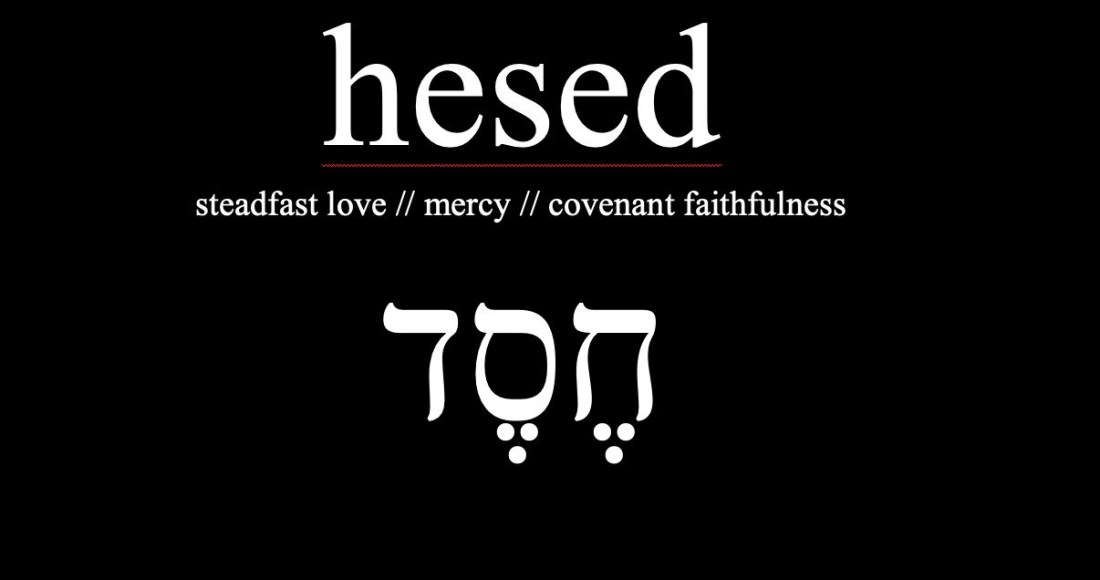
The importance of Hesed (חֶסֶד)

When we speak about God’s love, both in prose and in song, we find ourselves using phrases like ‘God’s love never fails’. To quote an old Hillsong tune, ‘your love never fails, it never gives up, never runs out on me’. In our day this is mostly construed in the soppy strains of the ‘Jesus is my boyfriend’-type songs, in which Jesus’ persistent and unconditional love are lauded as wonderful facets of his character in the face of our very human failure to be faithful to Christ and our failure to love and cherish him and his work.

These depictions of Christ, the patient but adamant suitor, have been dressed up well and are often the product of the colourful and intentional wording of megachurch bands who know what sells. However, there is another domain in which this faithful love, hesed, has not had so excellent a PR team: soteriology.

The profound, beautiful and thoroughly biblical truth that God’s hesed towards us is an effectual grace that will not tire, fault or fail is one that has been met with the straw-men of harsh reception. It usually goes like this:

‘God is a gentleman, and will not force himself upon you against your will. He stands at the door and knocks, but unless you invite him into your heart and make him your Lord and Saviour, he will not be joined to you.’

The key phrase in question is the modality of the word ‘force’. It suggests that his initiating action in commencing a relationship with you is inappropriate. By means of an example, consider the lifeguard. If a child is caught in a rip and takes in water and falls unconscious, unbreathing, the good lifeguard will take that child and immediately begin opening the airways and conducting CPR without waiting for the child to consent.

No one would ever say ‘did you see that lifeguard force himself upon that child?’ No. It is an apt analogy, because an unconscious and drowning child perfectly resembles the spiritual condition of all humans before they are Christian, namely, ‘dead in the trespasses and sins in which [the believer] once walked’ (Eph 2:1-2a).

In fact, it should be the bold and proud proclamation of the Christian that God did not wait for us to come looking for him, but initiated his relationship with us and was resolved to see it come to completion. With that understood, then we can stand in one mind with our brother Peter and say:

Blessed be the God and Father of our Lord Jesus Christ! According to his great mercy, he has caused us to be born again to a living hope through the resurrection of Jesus Christ from the dead, to an inheritance that is imperishable, undefiled, and unfading, kept in heaven for you, who by God’s power are being guarded through faith for a salvation ready to be revealed in the last time. (1 Peter 1:3-5, emphasis mine)

This truth bears on far more than just our personal understanding of how our relationship with God started. It bears on evangelism. Writing to the church in Ephesus, Paul shows us that God has set his faithful love on his people before the foundation of the world (Eph 1:4), and that those chosen people whom he foreknew, he predestined to not only hear the good news and accept it gladly, but to reach the end, and be glorified and fully conformed to the image of his son, Jesus Christ (Eph 1:5, Rom 8:29-30).

This means that when the Christian shares the gospel with an unbeliever, they can have the confidence of knowing that God will not fail to save sinners. Only in the confidence of God’s hesed can the Christian say ‘Repent and trust in Christ alone for your salvation. Do this, and you will find him to be a perfect saviour who will never let go of you, but will carry you through to victory.’

The Psalmist cherished God’s faithful love and this confident joy in the reliability of God is seen so beautifully in the 136th Psalm. Tracing out God’s glory and worthiness in eternity past, God’s creation of the world, his sovereignty over history in delivering his people from Egypt, his judgement of wicked nations and his faithfulness to Israel, every second line repeats that ‘his steadfast love (hesed) endures forever’ (Ps 136).

Let us join with the Psalmist and recognise that the same loving Father who created a beautiful world and people to rule and fill it, who guides the very course of its history and directs the hearts of kings like streams of water, is the same powerful God who does not wait for you to find him, but sovereignly acts to initiate a relationship with you by bringing you to life in Christ. Indeed, his faithful love rescues you from darkness, and for all your years on earth, and countless years after in glory, his steadfast love will remain on you.

Though Satan should buffet, though trials should come
Let this blest assurance control
That Christ has regarded my helpless estate
And hath shed His own blood for my soul

3 years and 24 units later

It’s pretty surreal to have finished university. A week or so after I submitted my final essay, I was thinking to myself, what did you learn? Well, I learnt a lot of really interesting and useful information about writing, history, literature, middle east politics, philosophy and so on, but that’s different.

Actually, my first class on my first Monday morning in first year proved very memorable. It was ACP109, Improvisation: Principles in Action. The central rule of improvisation is ‘Yes, and‘. It means you don’t shut down someone else’s offer, you always take it in your stride, embrace it and build on it. Yes, sometimes you have to make stuff up and follow the scene somewhere you didn’t expect it to go, but that’s the exact same thing that happens every day in real life.

However, to be perfectly honest, a ‘Yes, and’ philosophy is pretty superficial. In fact, 3 years and 24 units later, the best thing I learned is this: the God of the Bible, the only True and Living God, is in control, and I am not. The only reason that I can embrace whatever comes my way with a ‘Yes, and’ attitude is because “for those who love God, all things work together for good, for those who are called according to his purpose” (Romans 8:28).

So what did I learn? That my life will have been wasted if I chase success and happiness but do not cling body and soul to the King of all Kings. Also, that just because someone lives 10,000 miles away is not a reason not to date them.

Super-short fiction

There’s a poem by Seamus Heaney called Limbo which is chronologically back-to-front. I love it. I wondered if I could pull that off in short fiction, and so instead of writing out a complex plan for what the story would be and how to show it, I just started writing.

The result was this super-short story, a mix between the non-chronology of Tarantino and the detective fiction style of Raymond Chandler.

‘Phileos’, and talking around the subject

At some point near the end of 2018, a wonderful day was spent with my two closest friends from uni, at the time. You probably know as well as I do that as time passes we remember the major parts of these days, all the big picture elements. It’s the small details that go first. When I wrote ‘Phileos‘, I was seeking to capture all the little tiny bits that disappear from memory, in the hope that every reading would help me recall the small details that bring back the simplicity and wonder of such a day.

I do not explain what exactly is going on in the poem, but rather I approach it from all different sides, just not head on.

There are four Greek words for love, but Phileos is the fraternal, brotherly/sisterly love that sits at the base of enduring friendship.

‘Of the Seasons’: a closer look

I had great fun last year working on this poem, ‘Of the Seasons‘. It was an idea I’d started before, but it came time to submit work for uni so, naturally, time to dig up (and develop) old work.

The key idea is that each stanza correlates to a season, and each season has a ‘sound profile’. In writing metalanguage, the tool I worked with is called the sonic chain. Seamus Heaney referred to it as the ‘earscape’ of a poem. Each of the four seasons has the same line count and structure, with the final two lines of each five really hammering home the earscape.

Here’s the first stanza, Summer. Here, it is the /ɒ/ in ‘hot’ that creates that link, using the extension of that vowel sound to suggest lethargy and breathlessness.

The dry sun-sapped air forces even
the most brave of creatures back
to our air-conditioned cocoons.
Too hot to think, too hot to bother
Too hot that we’re all hot and bothered.

Here’s the poem, give it a read and then see if you can hear the sound of the season (yes, this may require reading out loud).

In the second stanza, autumn, it is the gentle, gliding vowel sound /iːv/ that brings on the image of gentle breezes and falling leaves that is iconic of autumn. For winter, the third stanza, the biting /ɒst/ sound, akin to gale force winds, is what creates an additional layer of texture and meaning on top of the words themselves. Finally, spring is where nature and the fourth stanza boom back into life with bold colours and sounds, something I achieved audibly with /aʊd/. What I succeeded in achieving in each of these examples is what Hutcheon (2006, p. 61) calls “a derivation that is not derivative—a work that is second but not secondary.” The poem succeeds standing alone, but is enriched when transformed into a performed, audible work.

Hutcheon, L 2006, A theory of adaptation, Routledge, New York

13 ways

For uni last year, I was given the challenge to mirror the poem Thirteen Ways of Looking at a Blackbird by Wallace Stevens. The challenge was to change the subject but keep the same energy and line count.

I created my poem, ‘13 ways of beholding the cross‘, in response. It was a great challenge and took a lot of focus, but most of all the challenge was in how directly I wanted to describe my subject — and the extent to which I managed to avoid doing so.

Here’s an example.

VI (blackbird)
Icicles filled the long window   
With barbaric glass.   
The shadow of the blackbird   
Crossed it, to and fro.   
The mood   
Traced in the shadow   
An indecipherable cause.
VI (cross)
Thunderclouds bellow rolling fury,
Cast saturating needles.
Down the splintering spine
Blood, sweat and water mingle.
Every darkness
Piled upon misery
An asphyxiated sentence.

This stanza is sharp and full of colourful, charged words. I noticed where the line runs on and where the line ends in a full stop. My main focus, however, lay on the last three lines. ‘The mood / traced in the shadow / an indecipherable cause’. It could mean ‘the mood, which was itself traced in the shadow, has a cause which is indecipherable’. On the other hand, it could be read ‘the mood, which had an indecipherable cause, traced something in the shadow’. The point is, the grammatical relationship between lines 1, 2 and 3 were ambigious, which enriched the reading.

I attempted to mirror that with my lines ‘Every darkness / Piled upon misery / An asphyxiated sentence.’ The first line could be the subject or the object of the second line, the verb clause. Either way, the third line stands up.

I encourage you to read Stevens’ poem and mine side-by-side, and see if you notice more similarities throughout.

Absolute madness

If you’d asked me in late 2017 or even early 2018, I would’ve called you mad for suggesting I put any of my work online. Especially poetry, regarding which I am very cagey. There is much that will never see the light of day (nor the electronic light of this blog).

I’m glad my friends encouraged me to put up some of my work though, because those that have taken the time to have a look have been very encouraging in their feedback.

So I’d really like to hear your thoughts: of my poetry, what do you like? More importantly, why?

An Étude

I sit down to dance
with paper and pen
a waltz penned in ink
at quarter to ten

the letters do dance
and step to and fro
I follow their journey
whither it should go

the rules are the rules
only when dancers rhyme
a waltz is a waltz
only in triple time

This is my craft
only my letters dance
every line a surprise
as if luck, as if chance

I picture a ballroom
of canvas A-four,
just as a ballroom
of polished wood floor

a palette of letters
a syllabic easel
where phrases will fly
and wind through the trees will

permit me this étude
permit me your ear
forgive my indulgence
ill end this right here.


Practising poetry with a traditional ABCB rhyme structure, rhythm and stanza consistency, I thought it would be fitting to use a dance/art allegory.

Also, as a meta-piece; work about my work, this might as well be the first thing that comes up on the page.

So this is a thing…

Thanks for joining me!

So a writing blog huh… Yeah well my Arts degree comes with compulsory coffee elitism and narcissistic self-importance so figured I might chuck up a blog where I can dump stuff that I write so if anyone wants to waste their time and read it they can! (without me having to email or such).

Let’s see how this goes…