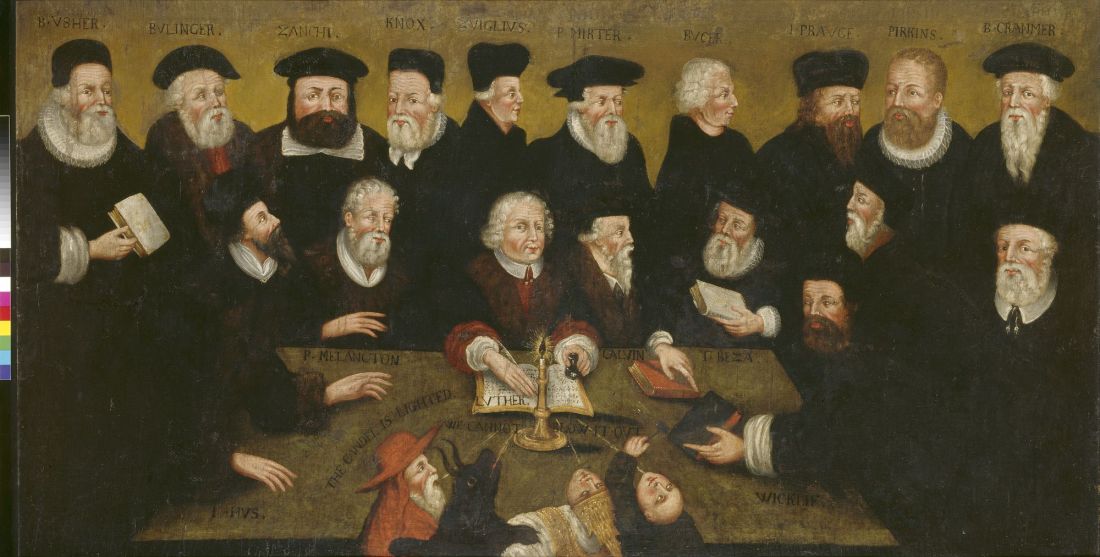
So, what are those Protestants Protesting about?

It is now nearly two weeks late to make a Halloween/Reformation Day post, but we made one last year, and this year this author wanted to clarify something he learned in the meantime.

There is a common misconception about the Protestant Reformation that we will briefly address here. The popular idea is that the Protestants were Christians who were ‘protesting’ Roman Catholic doctrine and practice, such as the selling of indulgences, the corruption of the Roman church, or the false gospel of justification by faith and works (this is a simplistic way of putting it, but the focus here is not Catholic Soteriology).

It is a somewhat romantic image, to imagine Luther and his zealous army of the Christian faithful protesting against the power in defence of the faith. Unfortunately, that’s about as fanciful as the idea of the French winning a war.

So, let’s briefly dig into history and get it straight. There was an important meeting of the Electors (in modern terms this would be like Ambassadors, Prime Ministers, political representatives) of the Roman Empire that met in a town called Speyer in Germany in the year 1526. At this meeting were the rulers of the land. Some were Lutheran, some Catholic. Since the majority were Lutheran, a vaguely-worded conclusion was reached that seemed to rescind the Edict of Worms (an edict from a council that met in the city of Worms) which outlawed Martin Luther and all his writings, at pain of death.

Whether or not the outcome of this decision was the intention of the Emperor Charles V, whose brother Ferdinand represented him at Speyer, the outcome was that the cities where Lutherans were in charge ended up being cities with some religious liberty, where these Christians could worship according to their faith.

However, only three years later, Emperor Charles V announced the Diet of Speyer (II), which met in 1529. One of the express intentions of this council meeting was to annul the outcomes of Speyer I, and in no uncertain terms make it that all the lands of the Roman Empire must worship according to the Catholic faith.

The Lutherans were troubled by this ruling not only because it meant that they couldn’t worship as Lutherans, but also because they were being bound by a secular authority in matters of faith. The legal structure and framework of these Diets (councils) meant that those electors who were unhappy with the majority decision of the Diet could formally protest the action and decision of the Diet. This is what happened at Speyer II. To switch to modern terminology briefly, the Lutheran politicians at the council who were in the minority submitted a document as a means of protesting the decision of the majority of the politicians, who were once again restricting their religious freedom.

This is where the term Protestant comes from. It is a political term referring to the politicians (electors) who opposed the decision of the council (Diet) at Speyer in 1529. It has nothing to do with indulgences, the sacrifice of Mass, transubstantiation, justification by faith, or any of that.


The spider’s web and Dead Orthodoxy

At a conference in 2018, Kevin DeYoung used a timely analogy for the manner in which the Christian should read the Scriptures: he said one must use the Scriptures not as ‘google’, to ‘know about God’, but as ‘Facebook’, to ‘know God’. The pursuit of knowledge, the pursuit of theology in the Scriptures, must be done with the desire to know God better. Otherwise, it may be at best vanity, and at worst pride bordering on idolatry.

If one holds the Bible at an arm’s length as they study it, and seeks to study it for the sake of merely summarising and systematising and documenting its teachings, they are wont to find themselves with dead Orthodoxy. A person could learn and recite the Chalcedonian Creed, Nicene Creed and the Westminster Shorter Catechism, but that in no way guarantees that they know God. In fact, they would have missed forest for the trees, since what God has revealed to us in his Word is that he came to make himself known to us. He wrote the Scriptures for us by human hands so that we could meet him therein.

Another reason that the Christian must hold his Scriptures tightly to his chest is that doctrine forms a spider’s web. The one who values ‘basic Christian truths’ but feels that rigorous understanding of the incarnation and hypostatic union are superfluous philosophising is like a spider who neglects part of her web, naively thinking that its disrepair won’t affect the structural integrity of the whole structure.

After all, the doctrine of Christ’s human and divine natures (the hypostatic union) strengthens the Christian in knowing that Jesus of Nazareth was a real human who lived a real, painful, fun, hungry, exciting, glorious life, and that because of this he truly can relate to you in your human experience. At the same time, his true Godhood reassures the believer that he is the terrifying and awesome judge at the end of Revelation who will cause all knees to bow, and who will separate all the sheep from the goats. If this doctrine is only a feather in your academic cap, a notch on your belt of supremacy over your brother and sister, but doesn’t draw you in a greater degree of Holy fear and awe to the foot of the cross in repentance for salvation, you have missed the point.

When you read Ephesians 1, consider your spider web. The letter has barely started before Paul says something mind-boggling.

Blessed be the God and Father of our Lord Jesus Christ, who has blessed us in Christ with every spiritual blessing in the heavenly places, even as he chose us in him before the foundation of the world, that we should be holy and blameless before him.

Ephesians 1:3-4a

This author is the first to admit that he struggles to even come to terms with the magnitude of this declaration, let alone feel the gargantuan display of affection and grace that it entails. Does your jaw hit the floor? Every spiritual blessing. However, many of us skip straight to ‘he chose us in him’ and verse 5 ‘he predestined us for adoption to himself as sons through Jesus Christ’ to either defend or work around the theological ramifications of the doctrine of election.

Should we not hang our heads in shame that the transcendent and incomprehensible God of the universe has made us his children and set his personal affection on us individually, and yet worship is not our first and foremost response?

Dead Orthodoxy is as much to be despised as blind faith. Our doctrine must be our pursuit of the one who lavished his grace upon us. We mustn’t hold doctrines and distinctives and finer points at an arm’s length because they challenge our presuppositions, but we must clutch his precious word close to our hearts, so that we can embrace its transformative power in our lives. Whether it is the doctrine of election, or of male headship, or of total depravity, or of the continuation of gifts, or of believer’s baptism, we must tend to each strand of our doctrine as strands of one web, a web that God has planned for us to traverse, that we may see his face.

The Stamp Collector

Hey there! This is a bit different from what I usually post. One of my final units at uni had me complete a group assignment in which we were to create a text-based branching narrative game with some software called Twine (which, by the way, is excellent, easy to use, and free).

If you don’t know what a branching narrative game is, it’s the same context as the old ‘choose your own adventure’ story books you may have read in childhood where you flip to different pages (as indicated) to see the story unfold in various different ways.

This concept was popularised very effectively by the videogame series ‘The Walking Dead’ (well known due to the AMC television series bearing the same name).

Well, in my group, it was my job to write the script of the story, and my partner’s job to put it in Twine. Sadly, I never saw the end product, and I know that my partner made some revisions to the story I created, so I figured hey why not, we’ve got another little (God-willing) lockdown, I might as well go and do his half of the assignment too!

One caveat I will make is this: 80% of this game was created in the final week of semester, so it is by no means perfect, and sometimes has disappointingly few ‘choices’ for a game based around the player’s freedom to affect the progression of the story.

Edit: I don’t know why this didn’t occur to me sooner, I’ve made a download link from my Google Drive. It’s an .html file so just download it and it will open in your web browser. Enjoy!

https://drive.google.com/file/d/11Uf-zWyJv28Rk51q0ON1O550QSCeiOSI/view?usp=sharing

3 years and 24 units later

It’s pretty surreal to have finished university. A week or so after I submitted my final essay, I was thinking to myself, what did you learn? Well, I learnt a lot of really interesting and useful information about writing, history, literature, middle east politics, philosophy and so on, but that’s different.

Actually, my first class on my first Monday morning in first year proved very memorable. It was ACP109, Improvisation: Principles in Action. The central rule of improvisation is ‘Yes, and‘. It means you don’t shut down someone else’s offer, you always take it in your stride, embrace it and build on it. Yes, sometimes you have to make stuff up and follow the scene somewhere you didn’t expect it to go, but that’s the exact same thing that happens every day in real life.

However, to be perfectly honest, a ‘Yes, and’ philosophy is pretty superficial. In fact, 3 years and 24 units later, the best thing I learned is this: the God of the Bible, the only True and Living God, is in control, and I am not. The only reason that I can embrace whatever comes my way with a ‘Yes, and’ attitude is because “for those who love God, all things work together for good, for those who are called according to his purpose” (Romans 8:28).

So what did I learn? That my life will have been wasted if I chase success and happiness but do not cling body and soul to the King of all Kings. Also, that just because someone lives 10,000 miles away is not a reason not to date them.

13 ways

For uni last year, I was given the challenge to mirror the poem Thirteen Ways of Looking at a Blackbird by Wallace Stevens. The challenge was to change the subject but keep the same energy and line count.

I created my poem, ‘13 ways of beholding the cross‘, in response. It was a great challenge and took a lot of focus, but most of all the challenge was in how directly I wanted to describe my subject — and the extent to which I managed to avoid doing so.

Here’s an example.

VI (blackbird)
Icicles filled the long window   
With barbaric glass.   
The shadow of the blackbird   
Crossed it, to and fro.   
The mood   
Traced in the shadow   
An indecipherable cause.
VI (cross)
Thunderclouds bellow rolling fury,
Cast saturating needles.
Down the splintering spine
Blood, sweat and water mingle.
Every darkness
Piled upon misery
An asphyxiated sentence.

This stanza is sharp and full of colourful, charged words. I noticed where the line runs on and where the line ends in a full stop. My main focus, however, lay on the last three lines. ‘The mood / traced in the shadow / an indecipherable cause’. It could mean ‘the mood, which was itself traced in the shadow, has a cause which is indecipherable’. On the other hand, it could be read ‘the mood, which had an indecipherable cause, traced something in the shadow’. The point is, the grammatical relationship between lines 1, 2 and 3 were ambigious, which enriched the reading.

I attempted to mirror that with my lines ‘Every darkness / Piled upon misery / An asphyxiated sentence.’ The first line could be the subject or the object of the second line, the verb clause. Either way, the third line stands up.

I encourage you to read Stevens’ poem and mine side-by-side, and see if you notice more similarities throughout.

Absolute madness

If you’d asked me in late 2017 or even early 2018, I would’ve called you mad for suggesting I put any of my work online. Especially poetry, regarding which I am very cagey. There is much that will never see the light of day (nor the electronic light of this blog).

I’m glad my friends encouraged me to put up some of my work though, because those that have taken the time to have a look have been very encouraging in their feedback.

So I’d really like to hear your thoughts: of my poetry, what do you like? More importantly, why?

So this is a thing…

Thanks for joining me!

So a writing blog huh… Yeah well my Arts degree comes with compulsory coffee elitism and narcissistic self-importance so figured I might chuck up a blog where I can dump stuff that I write so if anyone wants to waste their time and read it they can! (without me having to email or such).

Let’s see how this goes…