To dispense with the Crazies: a call for intolerance

An essential feature of maintaining the health of any ideological movement, or any religious tradition, is the willingness to actively police the boundaries of that group. It is my sincere opinion that, for the health of Western and Evangelical Christianity, we must no longer accept Dispensationalism as an expression of Christianity, and begin to apply soft pressure to it so that those espousing and practising it realise that they do not occupy the centre, and must experience constant low-level resistance if they want to abide in it.

Now, let me explain, and give a caveat.

Please read this essay in the genre of Manifesto. It is dialogical, in that I am inviting discussion, disagreement, and the refining of ideas. I am putting forth a suggestion at how we could correct the course of the Christian ship. These ideas may not be perfect, and I do not defend them all absolutely. Just read intelligently, you’ll be fine.

We know that war, even when justified in origin and just in manner, is a horrible thing. The reaction of most people to the news of war is dismay, even before they hear who the parties are, and who started it. Personally, I think that is the correct ‘default’ to hearing news of war, even if upon hearing the parties and circumstances one realises they support it.

I believe that most of you, most who will read this, would share the opinion that the USA and Israel’s war with Iran was and is a disaster. Since we are not yet far enough removed from it to have great clarity, we still suffer under the fog of war with all our analysis of the merits of this war. However, regardless of whether you make an argument about the necessity of the USD as global reserve or the necessity of USA-enforced rules-based world order, it is my opinion (and so I will also say it is plainly obvious) that no one wanted this war… Well, not quite no-one, but we’ll get to that.

Let’s wind the clock back. US Secretary of State Marco Rubio said to the press (paraphrased) that the US took pre-emptive strikes against Iran because when Israel attacked Iran, the US realised there would likely be repercussions for her own interests. Embarrassingly, this was Rubio saying the quiet part out loud. In other words, the US primarily started a war with Iran because Israel did something to provoke it. I say ‘primarily’ because the war-apologists will want to mention all the secondary motivations the US might have in such a course. However, the ‘but for’ test is compelling: But for Israel’s provocation of Iran, the USA would not have started that war.

Why do I mention all this? Well, let’s imagine that Trump approved the strikes, they knocked out the relevant targets, were satisfied that there was no more present threat, and ended the military campaign. Perhaps they’d have to deal with some retaliatory strikes in  the region, but that’s nothing out of the ordinary. A few press cycles later and a few mealy-mouthed diplomatic calls for peace later, it really could all blow over. However.

A particular religious tradition that was invented in the 19th century is sure that Jesus will return after a cataclysmic war in which the ‘State’ of Israel is the central protagonist, and she must survive a truly horrible battle with countries ‘from the north’ identified symbolically as being akin to Babylon, Egypt, perhaps Assyria and many others. This sect really wants Jesus to return soon, like imminently, so they are highly motivated to create the circumstances in which this war occurs and Jesus returns. In case you haven’t connected the dots, Dispensationalism is this sect, and its adherents believe that by galvanising and fueling the US/Israel war with Iran, they are ushering in the return of the Messiah.

Now, if your mind and heart are so enamoured with this apocalyptic doom narrative that you’re starting to find reasons to justify this theology or attack my character or motivations, I want you to be silent and just listen to me as a human person for a second.

The inescapable implication of that perspective is that you want countless millions of Iranians, maybe even more Iranians than the whole population of Australia, to die. You, as an ostensible Christian, are motivated by the idea that real human beings who could have been evangelised, who you could have made friends with online or on a holiday, whose culture you might have come to appreciate, whose profound and ancient heritage you might have paused to thank God for, would simply be wiped out. But not ‘simply’ wiped out, either. By the destruction of infrastructure and the embargos on trade, it will always be the poorest and weakest who starve and die first. Who are exploited by the oppressors, who have to sell their dignity to eat, who have to choose between which family members to feed or buy treatments for. Listen, you fool! The whole Bible instructs God’s people to give special attention to the fatherless, the widow, the poor and the sojourner (Zech 7:10). The very first classes of people to suffer are the very ones Christ commands you to show special compassion to. When you call for bombs to be dropped and when you lionise naval blockades, those Iranians don’t just stop existing painlessly (not that even that would be a good thing).

I’ll be straight with you. I hate, yes hate the fact that when discussing this foolish war, so many Christian westerners start by arguing about its merits or numbers of munitions or alleged WMDs, when the inclination of a Christian should instinctively be reluctance that such a tragedy should occur and compassion on the innocent who will suffer. In this respect, Tucker Carlson’s practical religion (though not backed up with the most rigorous systematic theology) is spot on in his desire for the image of God in every human being to be seen as deeply valuable, and thus to be deeply saddened and reluctant at the outbreak of any war. 

And, lest you begin with some anaemic pietist whining that hatred is category verboten, I must remind you that you do not love anyone if you do not hate anything. If you do not hate the sin that would destroy a loved one, if you are not willing to take up arms and lay down your life to fend off the sinful cause, you do not love them.

This strain of Dispensationalism that produces war-hungry and heartless aggression has intentionally and zealously worked towards exacerbating and expanding the war with Iran. Naturally, this has caused reasonable and fair-minded observers to judge the only form of Christianity they know (Dispy) to be immoral and ultimately subservient to areligious political goals.

This is a scandal because it dishonours the name and cause of Christ and his church. If there’s another thing I hate, it’s any movement that intentionally or otherwise brings genuine scandal and dishonour to my Lord and his Assembly. Please hear me. This is not some safe and academic argument over whether Cherubim should be classified narrowly as ‘angels’ or more broadly as ‘celestials’. I would not intentionally cause disturbance over trivial matters. We’re literally dealing with a sect that is pursuing world wars to wipe out the people we should be evangelising in the name of a God they are scandalising in the process, and all at the behest of an anti-Christian, corrupt, blasphemous, ethno-supremacist and morally licentious state. What the hell.

So, what kind of change am I calling for? Now I will explain some of the language I used in my thesis statement.

“We must no longer accept Dispensationalism as an expression of Christianity”

By this I do not mean that we should no longer accept Dispensationalists as Christians. The adherents may still be truly converted to Christ. Rather, I’m thinking about how we discuss the ‘genuine options’. When discussing Christian traditions that are true expressions of the faith, we would include the Methodists, Assemblies of God, Anglicans, Presbyterians and Baptists, but not the Unitarians, the Uniting Church, or the Mormons. In the same way, I’m proposing that when we lay out to a curious questioner what are the Christian views on the one thousand years of peace, we present them with the Historic Premillennial position espoused by Irenaus, Justin Martyr or J.C. Ryle; the Amillenialism of Augustine or Luther, or the Postmillennialism of Edwards, Warfield and Sproul. By leaving out the Dispensational option of Dispensational Premillennialism, we are judging that as not a ‘genuine option’ in Christian thought, but as some strange and eccentric blip in history that will pass.

This applies all across the board, to all the silliness about the Mark of the Beast being to do with AI or Bill Gates, to the idea that the modern secular licentious ‘state’ of Israel is in any meaningful way connected to the ancient ethnic nation of Israel, etc. If someone starts saying ‘because of my Christian faith I believe that God is only dealing temporarily with the Gentiles in the ‘Church Age’, but after the secret rapture he will resume dealing primarily with Israel, and they will resume animal sacrifices’, we can say, ‘well no, that might be your sectarian belief, but it’s not a Christian idea’.

I think you get the point.

“Begin to apply soft pressure”

Let me start by saying that this is not brash activism. This is not that insufferable and whiny racket caused by ‘Extinction Rebellion’ when they obstruct a road or deface an art gallery, like the undisciplined children they are. What’s more, this is not an incitement to commit an indictable offence.

Soft pressure is exemplified in the previous section, where my fictional speaker says ‘well no, that might be your sectarian belief, but…’. This is soft pressure. Though wicked in his motivations, means and ends, Klaus Schwab is correct when he identifies that the best way to influence a person to choose the option you want is for (a) the decision to be genuine (they really could pick either), (b) both options to be desirable (not choosing between your option and a pile of turd), and (c) your option to be just slightly more desirable/convenient. In supermarket terms, this is the difference between a product being somewhere between waist and head height (right in front of you), and being up on the top shelf (and slightly less stocked). No one is hiding the second option from you, it’s just a tiny bit less convenient.

In my argument, soft pressure would look like demonstrating disapproval with all social cues (facial and body language, laughing and nodding), and by creating situations where the Dispy person has to explain what they mean when they use their jargon: not letting phrases such as ‘the rapture of the church’, ‘God’s people Israel’, ‘this church age’, ‘wars and rumours of wars’ go by in conversation without asking them to explain what they mean by that, as if it is a foreign language. Side note: yes, I am aware that some of those words are in the Bible, but it is the dominant connotation borne by them that is the issue.

The goal is that the Christian espousing Dispy ideas is not sinned against, but that they don’t enjoy an inappropriate sense that what they believe is normal, readily accepted, based on well-known Bible proofs, or genuinely part of the Christian tradition.

“So that [they] realise that they do not occupy the centre”

The goal is for adherents of Dispy ideas to discover by themselves that their ideas are no longer in fact in the centre, and that they no longer appear to be in the centre.

What’s the centre? Basically, an idea ‘occupies the centre’ if it can be expressed without the reasonable expectation of resistance. Dispy ideas have been allowed to occupy the centre in American Evangelicalism both in fact and in appearance for far too long, although I believe that that is slowly shifting with the change in generations. The point here is not to try to convince and propagandise the Dispy person, because that is more likely to generate the defensive feelings that motivate re-centring their sectarian ideas. Simply create an environment in which they can discover that the ideas they assumed as default are no longer within the Overton Window.

“Constant low-level resistance

This is like being left-handed in a school that has only one pair of left-handed scissors in each room. It’s manageable (true in my case!) but far from convenient. Whenever you need to cut something, you have to ask for help in finding a pair. Help will be given quickly and genuinely, but the low-level resistance of having to ask for it is the point. Placing waist-high hurdles in someone’s path is too belligerent and might motivate them to remove the hurdles. Leaving sticky cordial residue on wooden floorboards is just… annoying.

Many clear thinkers have observed the way that real change can be enforced from the outside. If the status quo is at ‘0’, and you want it to get to 20, then start by moving it to 5. When the dominant culture pushes back, retreat to 1. They have won a hugely substantial victory, and the ‘appeasers’ in their ranks have taken a ‘nuanced’ approach to incorporating the ‘redeemable elements’ of your perspective, but broadly corrected the error. Then wait till ‘1’ becomes the true centre, fiercely defended by even the staunchest member (in current day polemics, this is like the ‘Christians’ who staunchly defend ‘a woman’s right to choose’ and ‘reproductive healthcare’, which are both dysphemisms for the sin of child sacrifice (abortion)).

Then it’s a rinse and repeat. Move to 6 or 8, let the correction push you back to 2 or 3. Be patient. The Marxists know this, and they did it to the educational system. Whether or not we implement this method, there’s no argument but that it works.

In conclusion, I am motivated by the integrity of the Christian tradition to cut off the deeply errant and counter-productive ‘Dispensational’ tradition by means of soft pressure over time. I am utterly persuaded that this sect has caused deep and serious and justified scorn to come to the public face of Christianity, and for that it deserves to be cut off. I am also motivated by a desire to show actual consideration and compassion, actual interest and beneficence towards Persians, of whom the least the last and lost will always be the first victims in any war. Christ’s church will grow in her maturity for all of human history until her doctrine is holy, consistent and orthodox. At the end of that period, the whole world will have experienced Christian evangelism and maturity, and we will be able to truthfully say that every tribe, tongue and nation have come to Christ, and are ready to worship before his throne for all eternity. Meanwhile, those who rejected Christ, along with every vain idea (including Marxism and Dispensationalism) will be thrown into the lake of fire.


Image credit: cottonbro studio

Giving God a reason

A big realisation I’ve had, and something that has really manifested itself in my prayer life, is that the Psalmists constantly give God a reason for what they ask. If you’re like me, you probably get the feeling that it’s somehow manipulative to suggest reasons to God for why it’s best to give us what we want.

But what I’ve realised, and what the Scriptures bear out, is that God trains us to share in his priorities by having us pray in such a manner that we name and rely and lean on the things he values. Whether he answers yes, no or wait, every time you pray on the basis of things he has revealed that he values, your prayers are producing in you a “like-mindedness” to God and his will.

We do not see our signs;

    there is no longer any prophet,

    and there is none among us who knows how long.

How long, O God, is the foe to scoff?

    Is the enemy to revile your name forever?

Why do you hold back your hand, your right hand?

    Take it from the fold of your garment and destroy them!

Ps 74:9-11

Here, the Psalmist very clearly lays out that he and his people are all out of help. It appears that God and his representatives on Earth are gone or silent. He asks ‘how long, O God, is the foe to scoff? / Is the enemy to revile your name forever?’ In saying this, he gives God a reason for why God should show himself and play his hand: God’s holy name is being dragged through the dirt by some enemies of the Almighty. That reason, the fact that God is the one being totally and perfectly worthy of worship, worthy of being honoured in society, is a wonderful and true teaching that we would do well to remember. God made the truth of that so very plain to our brother the Psalmist, and—I think you can hear it in his writing voice—he is clearly moved with emotion when thinking about the dishonour pointed towards God.

That is the basic framework of what I am arguing for. It is ok to simply pray ‘God, please let your name be honoured in society’. That’s good, that’s true—but the Scriptures go further. They teach us to say ‘God, why aren’t you acting? Your beauty and your goodness are being mocked all the day! How can you put up with that? Don’t let your people and the house that bears your name be destroyed and defamed. Show up for us!’

At this point, the fair-minded reader might be tempted to disagree: ‘Well hold on there, isn’t it really irreverent to suggest that we ought to pray in such a brash and impetuous manner? The constant refrain in Scripture is to submit to God’s will, to receive his inscrutable acts in our lives with faith, and to be patient since we know all his actions come right on time.’

Frankly, I find myself nearly tempted to agree with this rejoinder. Just like the ‘meat sacrificed to idols’ scenario, it is possible that a lawful option (Psalm-like prayers where we tell God why he should help us) might be a genuine stumbling block to someone, and so that person should ignore what I am advocating for, and not worry a single second more.

But if that’s not you, if you would love to have something more to grasp onto in your prayers, if you are prepared to become proficient in things that your father has said you are welcome to try, then I invite you to comb the Psalms. Let’s see some more examples. For space efficiency, I will embolden the phrases I want to draw attention to.

Remember this, O Lord, how the enemy scoffs,

    and a foolish people reviles your name.

Do not deliver the soul of your dove to the wild beasts;

    do not forget the life of your poor forever.

Have regard for the covenant,

    for the dark places of the land are full of the habitations of violence.

Let not the downtrodden turn back in shame;

    let the poor and needy praise your name.

Arise, O God, defend your cause;

    remember how the foolish scoff at you all the day!

Do not forget the clamor of your foes,

    the uproar of those who rise against you, which goes up continually!

Ps 74:18-23

I may have gone a little overboard with the long quote, but just look! See how many times he uses ‘imperative’ language, telling God to act. In particular verse 22, ‘Arise, O God, and defend your cause’. At no point is he disrespectful or entitled. At no point does he seek to sneakily imply that God is falling short in his actions.

So, friends, when you next pray for any cause, whether yours or that of a sister in Christ, mention to God why it would be in keeping with his will and his priorities for him to answer. Out with the:

‘well Lord, I don’t know if you want this or not, but if you do, I’d really like it if my friend would overcome her depression’,

and in with the:

‘God, now is the time to act! People are going to see that this man or woman who trusts in you is being hung out to dry right now, and they’re going to think that you’re a God who can’t really deliver your people, just like the Rabshekah said to Hezekiah. God, remember that you promised never to leave us or forsake us, and that it is your covenant faithfulness that we can rely on? Lord, help us!’

May God, who blesses us richly in Christ Jesus, enrich your prayer life. May you be joyful and triumphant.

The Light of the Law: Tav

Tav gives us a real sense of finality here at the end of this wonderful Psalm. You could summarise it as, “Hear my cry, I will praise you, be ready for me if I trip, I have not always done right”.

It feels like his last comments before he rises to action, like Frodo locking his front door at Hobbiton before setting off with the Fellowship. He just needs one more reminder that God is listening, God will help him and God will fetch him if he goes astray. Surely this author and the current reader can identify with that feeling. Let’s dive in.

Let my cry come before you, O Lord;

    give me understanding according to your word!

Let my plea come before you;

    deliver me according to your word.

119:169-170

There are five ‘let’ phrases in this poem, although there only seems to be a meaningful connection between these first two. They mirror each other quite closely, with the first phrase of both being ‘Let my (cry/plea) come before you’, and the second phrase being a request (for understanding/deliverance) ‘according to your word’.

On a practical note, the language here reminds this author that fervent and regular prayer is probably not a mild mumbling or a lukewarm listing of wants and concerns, but a cry. Too often this author’s prayer is more like recording a voicemail (in terms of passion and vigour) than coming before the all-powerful God of the universe who loves him.

It also really appears that this Psalmist prays with his Torah at hand, because in these verses as in much of the Psalm, he anchors his request in what he knows of God’s ways from his word. This is a good model for us. We should ask that God blesses us in accordance with his promises and with his word.

My lips will pour forth praise,

    for you teach me your statutes.

My tongue will sing of your word,

    for all your commandments are right.

v171-172

Just like the previous two verses, these two verses mirror each other quite closely. In both phrases he sings to God, either pouring forth praise or singing of his word. Then both verses establish that behaviour on the basis of God’s law, either in God teaching his statutes to the Psalmist, or in the recognition that all his commandments are right. Whenever we see a structure like this, we should take some time to consider and meditate on the pairing, and see what it has to teach us about the things it compares.

Did you notice that in v171 he says “you teach me”? This shows us that God is directly involved in our process of learning his word, whether in personal Bible study, in a Sunday School classroom, or otherwise. We do well to pray that God would give us understanding and true knowledge when we lead a Bible study or take part in one, because ultimately it his His Spirit who is present to build and furnish our souls with a mature knowledge of his statutes (cf. John 14:25-26).

There are two further points for consideration here. Firstly, our brother sings songs of praise because of his increasing knowledge of God’s word. This easily gives us reason to include in our Sunday Worship songs that speak of learning and reading his word, even though that is not currently en vogue in contemporary Christian music. Secondly, it makes sense that as we learn God’s ways more and more, as we have the powerful words of Scripture bouncing around in our heads more and more, that our souls would more naturally rise up in praise to God, even in small ways at small mercies. Praise is what all humans are built for, and those elect people who become new creations in Christ are praising in the only way that is good and beautiful.

Naturally verse 172 is much the same, and fills out our picture for us. We can sing about God’s word. It isn’t idolatry to love the Bible. All his commandments are right, so the Bible is the only book you can pick up where you never have to worry about spitting out the bones.

So, as a quick note of application, go find some theologically rich Christian music, especially some that references doctrine we learn in Scripture, and sing your heart out! After all, you’ll be doing it for all eternity.

Let your hand be ready to help me,

    for I have chosen your precepts.

I long for your salvation, O Lord,

    and your law is my delight.

v173-174

The language of this first line is so tender, like a child asking her father to stand by as she attempts a risky new feat like riding a bike or diving into a pool. As Christians we know that God’s hand is powerful, and that he is always paying attention and so could help us at any moment, but we are fallen humans, and it is reassuring to be reminded of it. As we noted at the beginning of this piece, language like this gives the impression that our Psalmist is about to rise and take action, and he’s looking for that last pep talk, that last skerrick of encouragement before he sets off.

What’s more, the request seems very sensible. God has given him rules about life. He has explicitly chosen to follow God’s rules. It makes sense that if he’s trusting God’s ways, he hopes that God would intervene on his behalf should calamity come knocking.

The second phrase is similar. He longs for God’s ‘salvation’. As we have previously discussed, this isn’t justification narrowly concerned, but more like vindication and deliverance generally. He appears to be looking forward to a time in the future where he expects that he will see God publicly come in to bat for him and ‘save him’, just as he asks God to be ready to stretch out his hand should he need it.

These two verses would make for a great couplet to recite before embarking upon street evangelism. It can be stressful or confusing sometimes, so calling upon God’s help and salvation makes a lot of sense, and hopefully these words will give us the courage to stand firm on his precepts and law.

Let my soul live and praise you,

    and let your rules help me.

I have gone astray like a lost sheep; seek your servant,

    for I do not forget your commandments.

v175-176

Verse 175 seems to summarise key ideas from verses 171-172, possibly 173. He asks for life so that he can praise God (similar to ‘pour forth praise’ and ‘sing of your word’ in v171-172), and he appeals to God’s rules to do so (just like the accompanying phrases in v171-172), and he uses the same structure (let your x help me) from verse 173.

Similarly, verse 176 may be hearkening back to v169-170, since those verses had the Psalmist ‘crying out’ to God, hoping that his pleas would reach God. That perfectly maps onto the image of one who has gone astray like a lost sheep, and is now hopelessly crying out and wondering if their pleas are heard, hoping that God will seek them out and deliver them. Following on, the phrase “I do not forget your commandments” matches the phrases from v169-170 in which he appeals for understanding and salvation according to God’s word, since his knowledge of and love for God’s commandments is like that last rope of safety that he can hold onto and appeal to as he asks God to drag him out of the muck.

To bring together and paraphrase the spirit of v169,170,176, we could say, ‘God I have lost my way and I’m crying out to you. It feels like you might not hear me since I’m so far away from you, but I hope you will. I’m relying on what your word says about how forgiving you are, and how you promise to keep your people safe in your hand. Please come and get me, I haven’t forgotten everything’.

Lastly, there is something very unique about v176. It is one of only two verses in all of Psalm 119 in which the Psalmist directly admits wrongdoing or sin (cf. v67 “I went astray”), and the only place where he asks God to seek him, and not the other way. This is such a cliffhanger and an unexpected turn in this Psalm, which has otherwise stayed extremely consistent in the kinds of statements and requests made. It is the last verse of the whole Psalm, and its inclusion here can be no accident.

Likewise, take note of the manner in which he says he has strayed: “like a lost sheep”. This is totally unlike the way that wicked people turn away from God’s law, which he describes in clear terms as decided moral rebellion. He is still God’s servant and sheep, but in his weakness and folly he has gone astray. So also, dear reader, you may find yourself from time to time like this. If you have become consumed with the worries of this world or the pride in your possessions, you might have lost track. You’re still God’s servant and the sheep of his flock, but perhaps you need the shepherd to come find you and bring you back. That doesn’t mean you have become the wicked one who disparages and maligns God’s law.

So, that’s it. That is the end of Tav, the end of Psalm 119 and the end of the final post in our series ‘The Light of the Law’. We have read through and commented on each poem in Psalm 119, and it has been an incredible journey, one that has shown the invincible goodness of God’s law, the incredible blessings of faithfulness, the very real struggles and pain of living in a fallen world, the need for supernatural work in our hearts if we would believe and live faithfully, and so much more. These words are words of light, and words of life. This author prays that they have encouraged and strengthened you, as they have him.


This article series will remain visible on this blog for some time, but in 2025 much of this will be taken down, since these articles will undergo editing and revision, some extra bits will be added in, and it will be compiled together into a book which this author will sell. We hope that if you have gained from these articles, that you will consider buying it.

God bless you all.

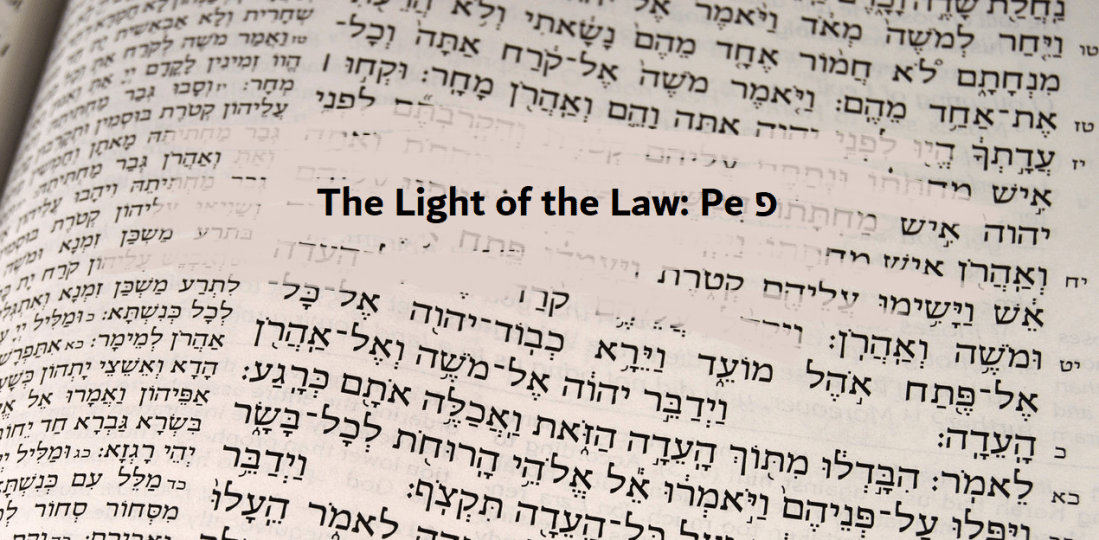
The Light of the Law: Pe

This next poem, Pe, is simply incredible, and does something this author has not detected from any other stanza so far. This poem seems to borrow its central themes and even some of its form from one of the most famous Old Testament passages: God’s benediction from Moses to Aaron and his sons in Numbers 6:22-27. Here is that text.

The Lord spoke to Moses, saying, “Speak to Aaron and his sons, saying, Thus you shall bless the people of Israel: you shall say to them,

The Lord bless you and keep you;

the Lord make his face to shine upon you and be gracious to you;

the Lord lift up his countenance upon you and give you peace.

“So shall they put my name upon the people of Israel, and I will bless them.”

The middle three lines (which are verses 24-26) are the core of this benediction, but we have given it some immediate context. As we dive into Pe, we’ll frequently make references back to this, and see just what beautiful and excellent things our ancient brother in the faith has to show us.

Your testimonies are wonderful;

    therefore my soul keeps them.

The unfolding of your words gives light;

    it imparts understanding to the simple.

119:129-130

First things first, we will kick this off with a comparison to Numbers 6. Verse 24 of that passage reads “The Lord bless you and keep you”. The adaptation that we believe the Psalmist makes in verse 129 here. The Lord’s testimonies are wonderful, they are a blessing. The Psalmist’s soul keeps them. In both cases there is something of a blessing and a keeping.

Now let us make an aside. If you consider your own soul, reader, whose words and whose ideologies are found there? Is your innermost being a place for Moses, or for Marx? Is your soul bouncing around with the words of Paul, or of Billie Eilish? You will know what you find wonderful when you discover whose words come most easily from your memory.

The Psalmist goes on to show one of the civilisation-building excellencies of the Law: it gives understanding and knowledge to the simple. Biblically, ‘simple’ isn’t an insult. It is a recognition that a person’s faculty of discernment has not developed much yet, so their moral compass isn’t fully formed, and they could still go either way. The simple need guidance, formation and teaching, but they are distinct from the wicked.

Truly, when you hear your pastor open God’s word to you on the Lord’s Day, a beacon of light is being unveiled before you. It is the deeply digested knowledge of God’s word that will fill your eyes with light and understanding.

Finally, the recognition that the Psalmist’s soul keeps God’s law shows that Old Testament worship was not behavioural (meaning that it concerned the actions of one’s hands), but in fact also concerned the inclinations of their hearts. This is a misconception put forth by some modern Orthodox Jews.

I open my mouth and pant,

    because I long for your commandments.

Turn to me and be gracious to me,

    as is your way with those who love your name.

v131-132

Verse 131 shows us what is the disposition and posture of one who has been powerfully changed by the grace of God: they are like an exhausted runner on a hot day, panting with longing for God’s commandments. Whether or not he knows and keeps God’s law isn’t a minor point for sometime in the future for him. He has seen the blessing of righteousness, and he’s putting in a mighty effort to learn it.

In the following verse we have the next reference to Numbers 6. Here is where it starts to get a little out of order, so screw on your thinking cap and follow along. Numbers 6:25 says “the Lord make his face to shine upon you and be gracious to you”. The second phrase there “and be gracious to you” is there almost word for word in Ps 119:132, rendering it in the first person as “and be gracious to me”. The interesting thing is that the phrase before this is “Turn to me”, which has similarities to both phrases from Numbers 6:25 and 6:26, which are “the Lord make his face to shine upon you” and “the Lord lift up his countenance upon you” respectively.

Whichever verse he was alluding to, the first part of 119:132 is clearly drawing upon Numbers 6:25-26. However, please don’t hear this as merely an intellectual or analytical observation. Praise the Lord, because you can apply this to your daily life! How? Well, what we’re seeing is that a worshipper of God has become really familiar with God’s word, and when he’s writing his own songs and poetry he borrows language and ideas from Scripture.

We can apply this today by letting the language of our prayers, and even the language of the songs we choose to sing to God, be moulded and shaped and imbued with Scripture. To give an example, this author will include a short prayer based on Numbers 6:24-26.

“Father God, please let me see your face today as I work and drive and eat and talk. Please let me feel your love like the warm sunlight, and bring me peace in the troubles I’m facing. I ask you this in Jesus’ name, Amen.”

We’re not done. There’s still one more reference in this passage! Following the benediction in verses 24-26, Numbers 6:27 says “So shall they put my name upon the people of Israel, and I will bless them”. This is showing us that God chooses a people, puts his name on them and blesses them. Ps 119:132 also links those two themes (turning to them and being gracious to them) with what we’re now looking at (those who love God’s name). One really remarkable thing to contemplate here is the link between God putting his name on a particular people, and those people loving his name. The beautiful truth is that when God puts his name on you, it isn’t a mere formality. His love changes you. His love elicits love from you. You love his name because he put his name on you.

The careful reader might object here, saying, ‘But my friend, do you not see that God puts his name upon the people of Israel, yet here you are making application from this passage to the church today? This is a category error!’. Seeking not to draw attention away from our selected passages, this author will simply say that worshippers of Yahweh today are brothers in Christ with worshippers of Yahweh since the beginning. That is a more complicated subject, and one for a different book.

Last thing, we promise! There is a profound truth about God’s nature to cling to here. Verse 132 says “as is your way with those who love your name” (emphasis added). For those who love his name, it is God’s way, his modus operandi, his habit, to turn to them and be gracious to them. Do you feel that God deals only in harsh measures with you? Do you worry that he is watching only your neighbours and family, but letting your catastrophes bank up, one after another? This author, the wretch that he is, freely confesses to feeling that way all too frequently in recent months. If this is you too, you are not alone in this mistake. Neither are you alone when you confess it and throw it down, and when you come pleading to Jesus that he would remind you of the grace you know you have been given.

Keep steady my steps according to your promise,

    and let no iniquity get dominion over me.

Redeem me from man’s oppression,

    that I may keep your precepts.

v133-134

If you are going through something tough right now, these two verses might just be the lifeline you needed. We almost can’t believe that we have such a firm handhold in the Scriptures to hold to, when the breakers and waves of life come crashing down on us. These verses let us plead to God and ask on the basis of His promise, that he would keep our steps steady and let no iniquity get dominion over us. To be totally honest, this author doesn’t know the ins and outs of where the line is between iniquity hitting us from every side vs getting dominion over us, so we probably shouldn’t expect this verse to shield us from all iniquity, but do not let the words of this mere man dilute the promises of God!

Secondly, it is a sad but sobering reality that God’s people have experienced and will experience the oppression of man for ages to come. Since Egypt, God’s people have been slaves, but since the Exodus we have also been free men. God gives his people the liberation from the ultimate slavery and bondage which is Sin, so that we can endure any oppression and slavery we experience in this life, all the while pleading with God to set us free, let us not be put to shame, and bring justice down on our oppressors. Just think about it. Today there will be many men and women living in countries where being Christian is dangerous, and those brothers and sisters would feel the pang of this verse stronger than we would.

If you can live freely as a Christian, praise God! If you are experiencing man’s oppression, grasp this verse with all you’ve got, and ask that your God would redeem you and help you walk in his way.

But wait, is there no Numbers reference here? Well, this author didn’t see any at first. However, when comparing which Numbers 6 sections had already been cited and which hadn’t, he noticed that the second half of verse 26 (“and give you peace”) had no corollary yet. As you may now realise, those two verses that we just read are exactly that: the Psalmist’s cry for peace. It is the peace that comes in walking faithfully, it is the peace that comes from conquering schemes of iniquity. It is the peace that comes from shaking off the shackles of oppression, and it is the peace that comes from living a quiet and holy life before God. Considered positively and negatively, v133-134 are cries for peace.

Make your face shine upon your servant,

    and teach me your statutes.

My eyes shed streams of tears,

    because people do not keep your law.

v135-136

Last but not least, we have one of the most clear citations from Numbers 6. Our passage here says “Make your face shine upon your servant”, whereas Numbers 6:25 says “the Lord make his face to shine upon you”. If this reference is obvious to a 21st century Christian who hasn’t memorised any of the first five books of the Bible, how much more obvious would it be to the Jews of the day who had? This entire Psalm would just be one obvious adaptation.

It is incredible to see what you get when you mix this single-minded devotion to God and his statutes from Psalm 119 with the grand blessing language of Numbers 6, and we see it encapsulated there for us in verse 135, which says one and then the other.Finally, this poem ends with a verse that complements and yet contrasts to the first verse (v129). Our poem opened with the blessing of God’s testimonies and how his soul keeps them, and it closes with how his eyes shed streams of tears at the reality that so many live their lives without a single care for God’s law. May we Christians today also feel sorrow for the many on this Earth who have never even heard the name of Jesus or met a Christian. It is incredibly sad, but also wildly exciting. God has lost sheep in all those nations just waiting for someone to come and preach life to them. May we bring his light to shine upon them.